Riot Games has officially revealed the inaugural VALORANT EMEA Clash, a 12-team online tournament pitting six VCT EMEA organizations against six Challengers representatives. The event runs from February 19 through February 25, with play days split across February 19-22 and February 24-25.
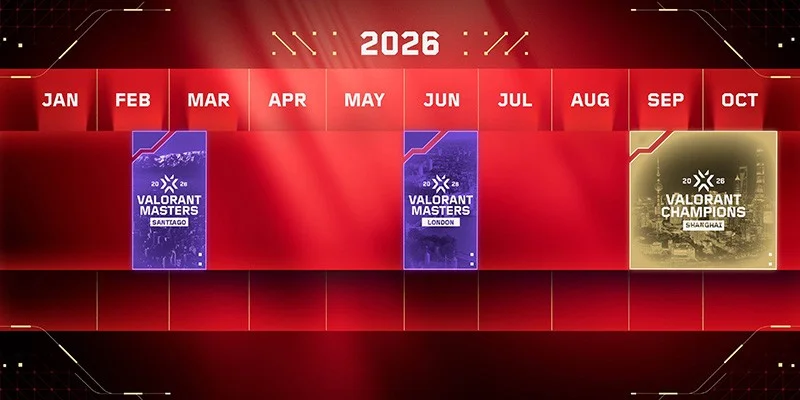
Filling the gap between VCT EMEA Kickoff and Masters Santiago, the Clash gives teams from both competitive tiers a stage during what would otherwise be dead air. The 2026 VALORANT season has barely left room to breathe as it is. The Kickoff wraps up, three teams punch their tickets to Santiago, and almost immediately this new battleground opens up.
Riot is hosting the event in partnership with Vanguard, the operator behind the VALORANT Challengers MENA league. Vanguard's involvement here marks a step up from their usual regional scope, bringing their tournament operations expertise to a broader EMEA stage. The partnership gives the Clash a more structured competitive framework while keeping the cross-tier "collision" identity that defines the event's concept.
Competitive Value Without Qualification
VALORANT EMEA Clash doesn't feed into any future VCT event. Unlike the Kickoff, which sends its top three finishers to Masters Santiago, this tournament is entirely standalone. No Masters spots, no circuit points, no direct pathway to a bigger stage.
That doesn't mean it's meaningless. For VCT teams that miss the Masters cut, it's structured competitive play during a window that would otherwise leave them sitting idle until April. Weeks without official matches can dull a team's edge, and the Clash offers a way to stay sharp.
For Challengers squads, it's one of the rare chances to play directly against Tier 1 opposition. Cross-tier matchups at this level almost never happen in a formal competitive setting, making every series a chance to measure up against the region's best.
That exposure matters more now than it used to. With the Ascension system removed for 2026, the pathway for Challengers teams has changed. The strongest Challengers performers now compete for a spot in VCT EMEA Stage 2 Playoffs instead. Getting reps against VCT-level competition is valuable preparation for that road, and the Clash is one of the few places to get it.
VCT EMEA Team Selection
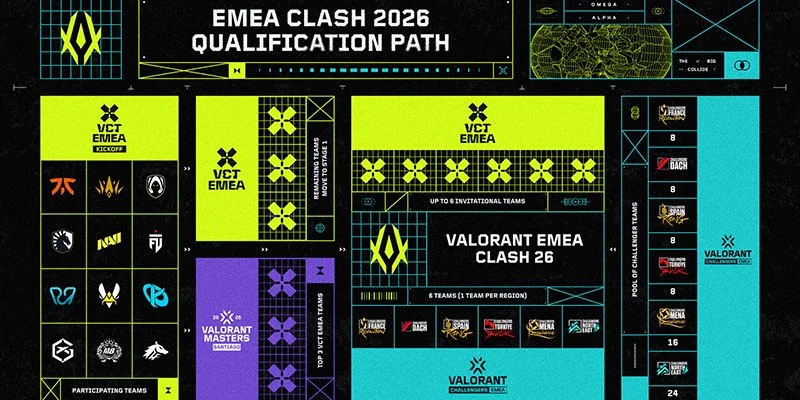
The VCT side of the bracket draws from teams that don't lock in one of the three Masters Santiago spots through Kickoff. Three teams head to Santiago, nine remain. From those nine, six will play in the Clash.
Participation is completely voluntary, though. Tomek Borowka, VALORANT Esports Product Manager, explained the selection process on social media:
So rather than automatically pulling the 4th through 9th place Kickoff finishers, Riot will take the six highest-placing teams from those who actually agreed to play. The opt-in model means the final roster of VCT participants won't be fully confirmed until Kickoff concludes and the willing teams are sorted by placement.
Notable Opt-Outs
According to multiple reports, Team Heretics, Fnatic, and Team Liquid have already told Riot they won't participate regardless of their Kickoff results. All three are among the squads that saw the most play time in EMEA throughout 2025, and the decision likely comes down to rest and strategic preparation. A short, intense tournament where VCT rosters face Challengers teams is a lot of risk with not much to gain for established rosters.
If those three fail to qualify for Santiago, they'll have no official competition until approximately April when VCT EMEA Stage 2 kicks off at the Berlin Arena. That's a long time without official matches, but these teams appear to have decided the break is worth it.
Their opt-out opens the door for other VCT rosters who could use the stage time. PCIFIC Esports and FUT Esports have already been knocked out of Santiago contention at the time of writing, making them potential Clash participants if they expressed interest. The first Kickoff match deciding a Santiago qualifier is set for February 13, a best-of-five between Gentle Mates and BBL Esports.
Challengers Representation
Six Challengers slots go to the top team from each of the following regional leagues:
- VCL NORTH//EAST: Kickoff
- VCL Spain Rising: Stage 1
- VCL France: Revolution Stage 1
- VCL DACH: Evolution Stage 1 Group Stage
- VCL Türkiye: Birlik Kickoff Group Stage
- VCL MENA: Resilience Kickoff Group Stage
Each representative is the winner of their region's first competitive split, so every Challengers team entering the Clash has already proven themselves as the best their circuit has to offer. Six regions, six champions, all thrown into one cross-tier bracket.
Alpha and Omega Bracket Format
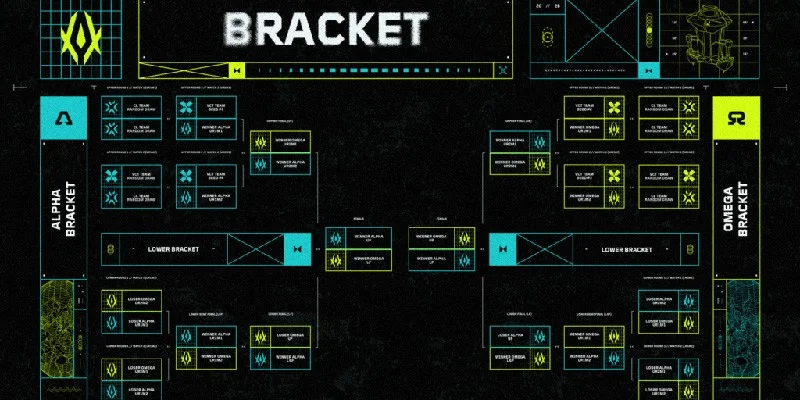
The EMEA Clash runs on a format Riot hasn't used before. Two double-elimination brackets, Alpha and Omega, operate simultaneously throughout the event. Each one crowns its own winner, meaning the tournament produces two champions: an Alpha Champion and an Omega Champion.
The concept draws from the dualistic themes in VALORANT's own lore, and Riot has leaned into that framing for the tournament's identity.
Seeding and the Draw
Bracket placement depends on Kickoff performance. The top four VCT EMEA teams (from those who opted in) receive a bye straight into Round 2, rewarding their stronger Kickoff showing with fewer matches to play early on.
The remaining two VCT teams and all six Challengers squads, eight teams total, enter a randomized draw to fill the Round 1 slots. One hard rule applies to the draw: the two VCT teams in this pool are guaranteed placement in separate brackets. Both Alpha and Omega will have at least one VCT team from the first round onward, preventing a scenario where one bracket is entirely stacked with Tier 1 talent while the other has none.
Crossover Mechanic
Alpha and Omega look like independent brackets on paper, but they're linked through a crossover system starting in Round 2. The short version: losing in one bracket's upper rounds doesn't always drop a team into the same bracket's lower rounds. Instead, it can send them into the opposite bracket entirely.
Here's how the progression works for a team starting in Alpha:
- Win Upper Round 1: Advance to Upper Round 2, staying in Alpha.
- Lose Upper Round 1: Drop to Alpha's Lower Round 1. Still the same bracket at this stage.
- Lose Upper Round 2: Transfer to Omega's Lower Bracket, not Alpha's. The same applies in reverse for Omega teams crossing into Alpha.
This crossover isn't limited to just Round 2. The later tournament stages, including Lower Round Semifinals, Lower Finals, Upper Finals, and Grand Finals, all feature matchups between teams that originally started in opposite brackets. As the tournament progresses, the two brackets become increasingly intertwined.
In practice, a team's lower bracket run doesn't just mean a second shot against familiar opponents. A loss at the right stage drops them into a completely different pool of teams with a different competitive rhythm. The second chance isn't a conventional fall through the same bracket. It's a full reset into a new competitive environment with new opposition.
Where to Watch
VALORANT EMEA Clash will broadcast live across multiple platforms and languages.
English coverage is available on both YouTube and Twitch. French broadcasts run on Twitch and YouTube, Spanish on Twitch, and both Turkish and Ukrainian streams are available on Twitch and YouTube.
Riot has also pointed viewers toward local Challengers channels, which may carry exclusive match coverage during the event. For fans following specific Challengers teams, those regional streams could offer angles and commentary that the main broadcast won't cover.
2026 Season Context
The EMEA Clash sits at a transitional point in the competitive calendar, bridging Kickoff and Masters Santiago while keeping both VCT and Challengers rosters active. It's a new addition to the EMEA schedule, and one that addresses a gap the region has had in previous years: meaningful competition during the windows between major VCT events.
For Challengers teams, it's a proving ground against the region's top tier. A strong showing could build momentum and confidence heading into the push for Stage 2 Playoffs. For VCT squads who miss Santiago, it maintains competitive sharpness during what would otherwise be a long layoff.
VALORANT esports continues to pull strong numbers heading into 2026. According to available viewership data, the game accumulated over 185 million hours watched on Twitch throughout 2025, with a peak of 696,000 concurrent viewers during VALORANT Champions 2025. Those figures put VALORANT fourth among esports titles on the platform, trailing only Counter-Strike 2, League of Legends, and Dota 2. Additional events like the EMEA Clash are part of Riot's push to keep that audience engaged throughout the full competitive year rather than just during tentpole events.
The action starts February 19.