The owner of PoE's largest third-party trading server lost his account, his Mirror shop, and over 1,500 irreplaceable items in a single morning. Grinding Gear Games permanently banned JeNebu's Path of Exile account on March 26, 2026. JeNebu is the founder and owner of The Forbidden Trove (TFT), the largest third-party trading Discord server in PoE history, with over 700,000 members.
GGG marked the ban as "Not Appealable." JeNebu's account held more than 1,500 items, many of them legacy mirror-tier pieces built with crafting mechanics from past leagues that no longer exist and can never be recreated. The ban also effectively kills TFT's mirror service operation, one of the server's main money-making functions.
JeNebu responded with a public meltdown across TFT's announcement channel, pinging all 700,000+ members repeatedly over 90 minutes. He invoked his clinical depression, his two children, and implied he didn't want to live anymore. The PoE community's response was overwhelmingly celebratory.
The reaction makes more sense once you know JeNebu's history. For years, he ran TFT like a personal fiefdom, banning competitors, manipulating the in-game economy, allegedly profiting from large-scale real money trading, and threatening anyone who got in his way. Players have been calling for GGG to act against him for the better part of a decade.
That call was finally answered.
What Is TFT?
The Forbidden Trove is a Discord server JeNebu created around 2019. He's gone by several names over the years: VMVarga, Il_Nam, furious1988. The server grew into the single biggest community hub for Path of Exile, dwarfing the official PoE Discord by roughly three times.
TFT existed because PoE's official trade system had gaps. Big ones. GGG's design philosophy historically favored player-to-player interaction over automated trading, which meant a lot of common transactions were slow and tedious through official channels. TFT filled those gaps, and for a long time, it was the only option for high-end play.
The Vouch System
TFT ran a reputation system built around "vouches." When a player helped another player with a service (crafting, boss carry, bulk trade, anything), the recipient could leave a vouch. These accumulated and unlocked progressively higher trust tiers across nine total ranks.
The first rank, Trusted Service Provider, required roughly 15 to 20 vouches. Without it, certain features were off-limits, including the ability to sell builds and host 5-way experience farming groups. Higher ranks signaled greater reliability and opened more server features.
The system addressed a real problem in PoE's trading model. Many services required handing over valuable items to another player (giving someone your gear so they could apply a bench craft, for example). The vouch system gave users a way to gauge whether a trading partner was trustworthy.
TFT also ran a Chrome browser extension with over 60,000 users. The extension displayed warning popups when interacting with TFT-banned or flagged players, extending the system's reach well beyond the Discord server.
TFT's Services
Bulk Trading was the most broadly useful feature. Players could buy and sell large quantities of maps, scarabs, essences, currency, bases, Pale Court boxes, Beast relics, and more in single transactions. A player could grab 1,000 copies of a specific T16 map from one seller on TFT instead of spending four hours buying them one at a time from the trade site. Prices ran slightly higher than the trade site, but the time savings were massive. Players could also post their own bulk sale listings through message templates.
Boss Carry Services let players hire experienced players to kill bosses they couldn't handle. This covered everything from story bosses to endgame encounters like Maven, Uber Elder, and other high-difficulty content. The vouch system helped ensure carries were reliable.
Crafting Services gave players access to bench crafts they hadn't unlocked. In earlier PoE versions, many powerful crafting options (Syndicate bench crafts like Aisling slams, Veiled Orb applications) couldn't be traded as items. The only way to access them was to find another player with the craft and trust them with your item. TFT's vouch system made that possible.
Mirror Services were TFT's most profitable and controversial offering. Mirror-tier items are the best items in PoE, representing hundreds or thousands of hours of crafting work and enormous currency investment. Players use a Mirror of Kalandra (one of the rarest items in the game) to copy these items. TFT's mirror shop charged fees on top of the mirror cost, and these fees were a constant source of anger among players. Some Standard items carried fees of several mirrors, with each mirror worth hundreds of divines. Reports of 80-divine fees for a single item in the first week of a league were not uncommon.
5-Way Carry Services let players pay to join Domain of Timeless Conflict groups for fast experience. This was a popular method for leveling alts or pushing to level 100 without the mapping grind.
Beyond these core services, TFT also hosted gold rotation groups, experience rotations, challenge completion services for players chasing 40/40, and build sales for players at higher trust tiers.
Why TFT Felt Mandatory
At its peak, TFT wasn't a nice-to-have. It was the only realistic way to do business at PoE's high end. Bulk map buying, efficient scarab selling, unlocked bench crafts, boss carries, mirror items: all of it ran through TFT.
That mandatory status gave TFT, and JeNebu by extension, enormous power over the PoE ecosystem. Getting banned from TFT didn't just mean losing access to a Discord server. It meant losing access to major portions of the game's economy and services.
Who Is JeNebu?
JeNebu built TFT from the ground up starting in 2019 and maintained control over it for its entire existence. About two years ago, he claimed to have "stepped down" from leadership after a major controversy. The community never believed it, and the events of March 26, 2026 confirmed he'd been running things the entire time.
His real-world identity and location have been subjects of speculation. Various players have claimed at different times that he's Russian, Romanian, Serbian, Croatian, or Israeli.
JeNebu's In-Game Wealth
JeNebu's account was one of the richest in PoE history. His 1,500+ items included legacy mirror-tier pieces from Standard league built with crafting mechanics that no longer exist: Crucible modifiers, old synthesis implicits, legacy modifiers, and other mechanics that have been removed or fundamentally reworked over the years. His collection also held demigod items and alternative art pieces, both of which exist in extremely limited quantities.
Community estimates put the total value in the tens of thousands of mirrors. Beyond raw currency value, his account held the original items used for TFT's mirror service. With those items on a banned account, they can never be mirrored again. They're effectively deleted from the game.
JeNebu also owned one of the copies of the infamous bugged 25,000 fire resistance chest, a Standard legacy item from an old game bug. The best version of this chest was given to JeNebu about two months before his ban. It's gone now. Players who owned mirrored copies immediately started listing them at inflated prices (10+ mirrors, up from the previous 4-mirror price).
Alleged Real-World Earnings
Estimates of JeNebu's real-world income from PoE vary, but community speculation consistently places the figure between $50,000 and over $100,000 per league through alleged RMT.
An analysis from an earlier league documented JeNebu holding 5,000 Hinekora's Locks when they were worth 30+ divines each, with mirrors trading at roughly 850 divines. That worked out to approximately $15,000 in just that single item type at estimated RMT rates.
He also allegedly acted as a middleman for players selling multi-mirror items for Bitcoin. None of these figures have been independently confirmed, but the sheer volume of assets on his account, the scale of TFT's mirror operation, and the fact that he spent 16 hours a day on the game for 8 years while supporting a family all point toward major real-world income from the game.
JeNebu's Self-Described Mental State
Players who interacted with him on the server say JeNebu openly stated on TFT that he has schizoid personality disorder and antisocial personality disorder. In his post-ban messages, he called himself "a clinically depressed person" on several occasions and acknowledged his past behavior, admitting he "truly deserved" the community's hatred and "was a horrible person" who "shouldn't have acted like I did many times."
The Ban
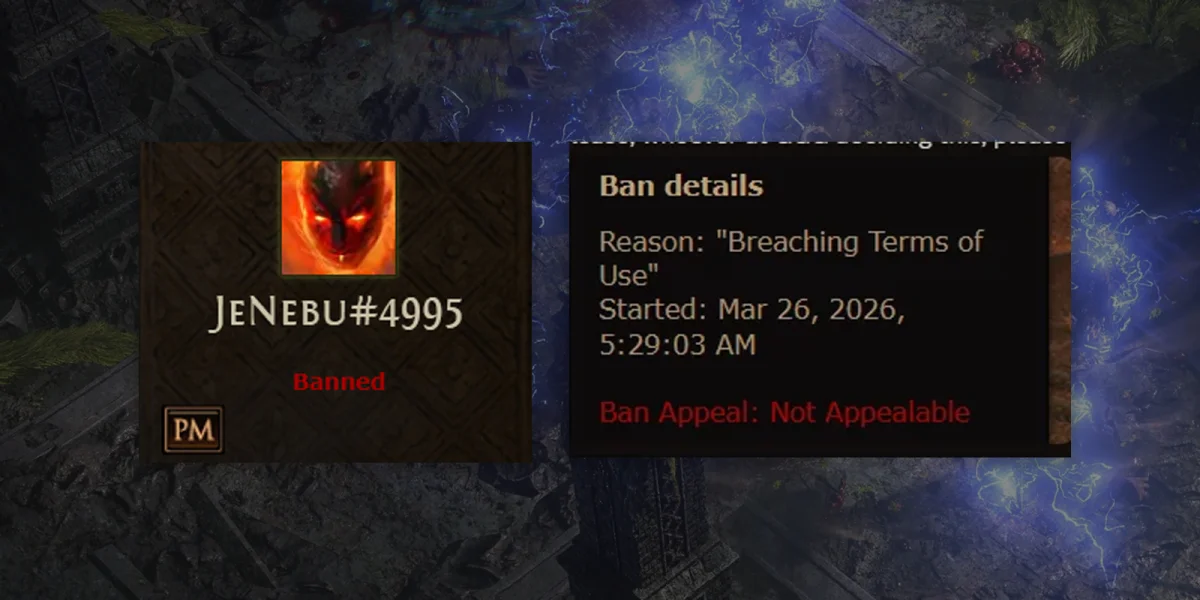
JeNebu's account was banned at 5:29 AM on March 26, 2026. He shared a screenshot of the ban details in TFT's announcement channel. The reason listed was "Breaching Terms of Use." The appeal status: "Not Appealable."
This wasn't his first ban. JeNebu had a history of getting banned and unbanned from PoE, with previous bans overturned through appeals. This time, the appeal was denied, and that's what triggered the extreme reaction.
The ban came a few weeks into the current league, and the prevailing theory is that GGG was monitoring his activity, he did what they expected, and they pulled the trigger.
GGG didn't release a public statement explaining the reason. The company has never publicly disclosed reasons for individual account actions, and players don't expect them to start now.
JeNebu's Public Meltdown
After the ban, JeNebu posted a series of increasingly desperate messages in TFT's #tft-news-updates channel. He pinged @everyone (all 700,000+ members) with each one. The posts escalated over roughly 90 minutes and followed a pattern the community immediately labeled as manipulative.
First Message (7:41 AM)
JeNebu introduced himself as the server owner and announced that his account had been banned "completely all of a sudden, without any prior warning or any message from anyone."
He framed the implications as massive, claiming the ban "permanently destroys PoE 1 Standard and this server" because his account hosted over 1,500 items, some of which can never be recreated. He called TFT his life and described himself as "a clinically depressed person who dedicated his life to POE for 8 years."
The message ended with: "This is the worst day of my life, and honestly I don't want to live anymore. Please reconsider this and talk to me."
Second Message (8:23 AM)
His longest message reported that GGG was giving him "really cold responses" and wasn't willing to look into it further. GGG told him he could make a new account. He refused, saying his current account held "8+ years of PoE legacy and everything thousands of people invested years into."
He defended TFT's record, claiming they never attacked the game or company publicly. He acknowledged his past more directly, admitting he "truly deserved" his haters' disdain and "was a horrible person." He also claimed to have built free tools like the PoB Viewer "for hundreds of hours just purely out of passion."
Third Message (8:41 AM)
JeNebu said he was receiving hundreds of DMs, some encouraging and some telling him to kill himself. He directed this at GGG, asking if this was what they wanted.
For the first time, he brought his children into it: "I am a father of 2 kids, one a 6 month old daughter and a 8 year old son, I am a clinically depressed person who you just killed even more." He asked the community to contact GGG support on his behalf.
Fourth Message (8:59 AM)
His last recorded message was a plea for anyone with GGG connections to help resolve the situation "even temporarily." He maintained he never had "ill intent for the game" and was "willing to discuss anything about anything."
What Was Missing
Across all four messages, JeNebu never once stated what he was actually banned for. He never denied any specific allegation. The community read this as a tacit admission that whatever GGG caught him doing was something he couldn't publicly deny without making things worse.
The Mod Threat
The situation escalated further when a TFT moderator reportedly threatened to "nuke ExileCon" if the ban wasn't lifted. Players called for GGG to file a police report, calling it a serious threat regardless of whether it was genuine.
Discord Chaos
While JeNebu posted his messages, the TFT Discord descended into chaos. Moderators were furiously deleting messages. Players who commented on the situation in general chat were banned within 30 seconds of posting. Chat channels were hidden to contain the fallout. The scene was described as "a bloodbath."
TFT's Full Controversy History
JeNebu's ban didn't happen in a vacuum. The PoE community's years of pent-up frustration trace back to a long list of specific incidents. Each one added fuel. By March 2026, the pile was enormous.
The LocalIdentity Ban
This is the incident that made TFT a household name for all the wrong reasons. LocalIdentity, a beloved and well-known figure, maintains the community fork of Path of Building (PoB), easily the most critical third-party tool in PoE. The original PoB was created by Openarl, but after they no longer had time to maintain it, LocalIdentity built the fork that became the standard version used by virtually all players.
It started when JeNebu listed an item for sale at a specific price on the trade site, but refused to sell it when someone tried to buy it. He called it a "showcase price." The buyer posted about the experience on Reddit. JeNebu DM'd the buyer aggressively and banned him from TFT. LocalIdentity then made a comment poking fun at this "showcase price" practice.
JeNebu banned him too. In private messages that were later shared publicly, JeNebu called the PoB maintainer "garbage" and threatened to "humiliate you in front of your viewers." The community reacted with disbelief.
Cascade of Creator Bans
The LocalIdentity ban triggered a chain reaction that exposed just how far TFT's surveillance network reached. SpicySushi, a prominent PoE streamer and mirror crafter, laid out the full sequence during a stream.
A friend of SpicySushi's had items listed on TFT's mirror shop. He asked for them back because they weren't getting serviced, and players can't use their own items while they're listed on TFT's mirror service. JeNebu was "slightly annoyed." The friend got trade-restricted on TFT.
The friend went to SpicySushi's Discord and complained. TFT banned him. Not for anything he said on TFT, but for complaining in a completely different Discord server.
SpicySushi recalled what happened next: "He said I just got banned and I laughed at that. I literally lmaoed at that and said 'That's crazy' or something like that. I was like, 'Man, that's cringe that you got banned for that.' Then they banned me for saying it was cringe."
Streamer Ruetoo got banned next for laughing about the situation on his own stream. After Ruetoo, the rest of the PoE creator scene fell like dominoes. As SpicySushi put it: "So they just started banning every single Path of Exile creator. Like, a really great way to look amazing in the community if you're banning literally every creator."
The cascade confirmed what players had long suspected: TFT had operatives planted in other Discord servers, screenshotting any criticism and reporting it back. Anyone caught complaining about TFT in any Discord got permanently banned.
Clown Emoji Bans
TFT became infamous for banning members who posted the clown emoji (🤡) in response to server announcements. Players reported getting banned for a single emoji. What started as a joke became a symbol of resistance against TFT's moderation.
The Chrome extension's role made these bans more damaging than a typical Discord ban. With 60,000+ users, the extension would display warnings when trading with banned players, labeling them with negative tags even if their only offense was an emoji. Getting kicked from TFT could actively hurt a player's ability to conduct normal trades outside the server.
During the initial controversy two years ago, TFT briefly renamed the entire Discord server to "The Reddit Tears." After JeNebu's 2026 ban, the top-voted comment on the Reddit threads was simply "🤡." Full circle.
Price Fixing and Market Manipulation
JeNebu used his resources and TFT's platform to manipulate the PoE economy repeatedly. The documented incidents span many leagues.
Watcher's Eye manipulation followed a systematic approach. JeNebu would buy up the best Watcher's Eye jewels from the trade site, then reprice them at dramatically higher values (3-4 mirrors). Items that didn't sell at those prices moved to Standard for later sale.
Hinekora's Lock hoarding during the Ancestor league saw JeNebu accumulate 5,000 Hinekora's Locks at 30+ divines each, with mirrors at approximately 850 divines. At estimated RMT rates of roughly $85 per mirror, that single item type represented about $15,000 in real-world value.
Timeless jewel manipulation involved buying up jewels with desirable rolls and threatening TFT blacklisting against players who refused to sell.
Charge ring price control was visible to anyone watching the market. Frenzy and power charge rings would vanish from listings so JeNebu could cap their price at 1 mirror through TFT's mirror ring service by the end of the first week of a league.
Forced sales weaponized TFT bans as economic leverage. Players who listed items and then reconsidered after getting a whisper from JeNebu were banned for "wasting his time." Ironically, his position was that once an item was listed at a price, the seller was obligated to sell.
Personal encounters with this system surfaced after the ban. One player described being bullied for selling a Forbidden Flesh jewel for 2.8 mirrors because JeNebu was selling his at 3 mirrors and accused the player of "devaluing" his stock. Another recounted listing a triple-Hatred-mod Watcher's Eye and being spammed within minutes by TFT members telling him to raise the price or "face the consequences." A third was PMed to sell mirror-tier armor to JeNebu "or get problems," and was banned for price-fixing after ignoring the message.
Mirror Service Monopoly
TFT's mirror shop charged fees the community widely regarded as predatory. Obviously, for a service, you would need to provide a Mirror of Kalandra itself, an extremely rare and highly sought-after currency. Extreme TFT's fee that came on top of such an interaction hurt, and for some Standard items it could run into several mirrors.
Competition eventually forced some prices down. Echo Mirror Shop, built largely by Goro (a former TFT crafter), and SpicySushi's Settle Shop both offered significantly lower fees. As SpicySushi explained on stream, crafters offering free or low-fee mirror services were seen as direct threats to TFT's profit model.
On the Chinese (Tencent) servers, the situation was reportedly even worse. Someone who tried to offer free mirroring services had their original item purchased by the TFT-equivalent operation through unknown means, effectively killing the competition.
Threatening a Crafter's Wife
About four months before the ban (around November 2025), a Reddit post documented JeNebu threatening the wife of Goro, TFT's former top crafter who had left for Echo Mirror Shop. JeNebu was reportedly furious about losing his best crafter to a competitor and tried to pressure Goro back through intimidation that targeted Goro's family.
The backlash was fierce. Others called for police involvement. The Reddit post was eventually removed by moderators, but the community didn't forget. Goro's departure proved significant beyond the drama, as his group's competition through Echo drove TFT's fees down considerably.
The Surveillance Network
The cascade of creator bans confirmed that TFT operated a surveillance network across the PoE Discord ecosystem. But it extended beyond just monitoring chat for criticism.
TFT automatically banned any member who was also a member of Belton's Discord server, a competing community. Not for any behavior. Just for being on the server. Complaining about TFT in any Discord, on any subreddit, or even being associated with people who criticized TFT was enough to earn a ban.
There were also allegations of TFT placing Discord bots on other people's servers to log messages, though concrete evidence for this specific claim was described as lacking.
The ckaiba9 Campaign
TFT waged a targeted campaign against ckaiba9, a Russian player and streamer who provided free mirror services. Free mirror services directly threatened TFT's profit model, and the response was aggressive. JeNebu and TFT's leadership allegedly organized mass reporting campaigns against ckaiba9 in the hope that GGG would auto-ban him or that he'd quit.
Leaked private messages from JeNebu during this campaign included calling a streamer a "pedophile."
The Wider Server Culture
JeNebu wasn't the only problem. TFT's broader moderation team was implicated in similar behavior. A moderator known as "Nell," widely considered JeNebu's right hand, was accused of conducting emotionally driven bans and following the same patterns.
One anecdote captured the moderation culture perfectly: a TFT moderator had his Spotify account linked to Discord, displaying his real first name on his profile. When a player called him by that first name (publicly visible on his own profile), the moderator banned the player for "doxxing." He then unlinked his Spotify account but never unbanned the player.
The "Stepping Down" That Never Happened
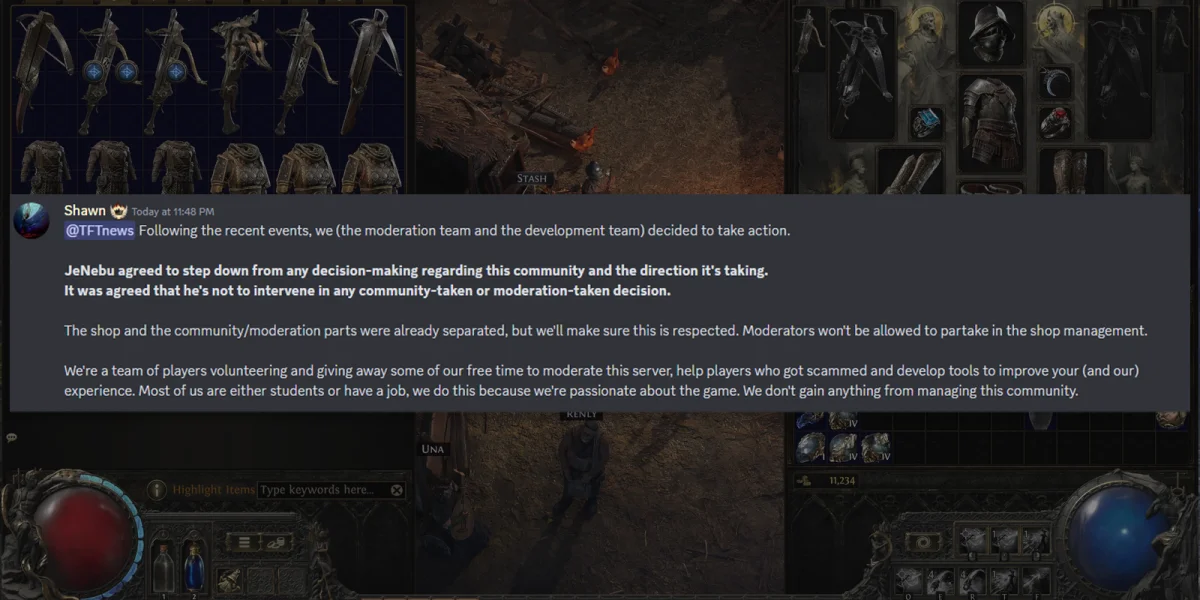
About two years before the March 2026 ban, after the mass banning of content creators blew up on Reddit, TFT posted an official statement. A user named "Shawn" announced that the moderation and development teams had "decided to take action."
The key line: "JeNebu agreed to step down from any decision-making regarding this community and the direction it's taking."
The statement promised reforms. The shop and community/moderation functions had been separated. Moderators wouldn't participate in shop management. Banned players could appeal. People wouldn't be banned for emojis anymore. Blacklisted players could appeal for reversal.
It also attempted to humanize JeNebu ("He's just like you and me. Sometimes we make mistakes, and he made some") while trying to undermine the evidence against him ("Keep in mind screenshots can be cropped, and 'proof' from text editors can be edited").
Nobody Bought It
The community saw through it immediately. The top response compared it to a CEO stepping down while still owning 51% of shares. Others called it a puppet ruler arrangement.
PaintMaster, a PoE YouTuber, delivered one of the strongest reactions: "Funny, leave TFT, and let it die already. Not believe in any of this for a second. They will do everything to keep you there and keep making a lot of money."
The "we all make mistakes" framing drew especially sharp reactions. The contrast was laid out plainly: "Our mistakes: posting 🤡 emotes on completely different discord servers. JeNebu's mistakes: just a bit of light extortion, intimidation and racketeering. We've all been there."
Confirmed as a Facade
SpicySushi confirmed on stream that JeNebu never actually stepped down. He was caught banning someone again shortly after the announcement.
The events of March 26, 2026 removed all remaining doubt. JeNebu identified himself as "the owner of the server," made statements about TFT's future being tied to his personal account, and behaved like someone who'd been running things the entire time.
Community Reaction to the Ban
Reddit lit up. Multiple threads across r/pathofexile and r/PathOfExile2 accumulated thousands of upvotes. Moderators on both subreddits eventually locked the threads because comment sections were getting out of control, though they were "being somewhat more tolerant since this is a public figure."
The mood was unmistakable. Comments ranged from "BEST PATCH THIS LEAGUE" to various internet memes to "This is beautiful." Players who'd been personally targeted by JeNebu showed up to share their satisfaction and tales of woes.
Response to the Emotional Manipulation
The community tore into JeNebu's emotional appeals. His statements about not wanting to live were widely read as emotional blackmail aimed at GGG, with the community drawing a direct line to his broader pattern of manipulative behavior. Several users posted links to Discord's abuse reporting page.
His invocation of his children drew anger rather than sympathy. The community pointed out the math: 16 hours a day for 8 years, with an 8-year-old son. The consensus was that his children were being used as emotional leverage, not that he was genuinely concerned about them.
A quote from JeNebu himself, posted on January 22, 2024, resurfaced: "TFT will not cave in to crying posts on reddit." Two years later, he was the one writing crying posts to his 700,000-member server. The irony of a serial banner getting banned wasn't lost on anyone.
The Chris Wilson quote became a recurring punchline: "As Chris Wilson stated it back when GGG nuked Standard economy by swapping Exalted Orbs with Divine Orbs: 'You should have diversified your assets.'"
Voices of Concern
Some players addressed the broader issues at play while still supporting the ban. Gaming addiction was a recurring theme, with players drawing parallels to substance abuse and gambling. Internet Gaming Disorder is recognized by the WHO's International Classification of Diseases. The DSM also includes Gaming Addiction in its "needs further research" section, which typically means inclusion in a future edition.
The RMT Question
GGG didn't publicly state the reason for the ban. The ban notice says "Breaching Terms of Use," nothing more. The overwhelming community consensus points to real money trading.
Circumstantial Evidence
JeNebu spent 16 hours a day on the game for 8 years while supporting two children. That requires income. He allegedly middlemanned multi-mirror item sales for Bitcoin. His mirror service operation generated massive in-game currency flow that could be converted to real money. His entire reaction focused on losing his assets and income, not the gameplay itself. He declared he'd "never" make a new account because the value was in his existing holdings.
Why RMT Matters
RMT inflates the in-game economy beyond what legitimate players can keep up with. Without RMT, the most expensive items can only be priced at what the richest legitimate players can earn through gameplay. Once RMT enters the picture, buyers have far more currency to spend, and prices get pushed beyond the earning capacity of non-cheating players. If you've ever watched an expensive item's price climb out of reach faster than you could farm currency, RMT is a major factor.
The ban also has deterrent value. Other RMT operators now know that even years of operating with apparent impunity don't guarantee safety. Hardcore league, with far less botting and RMT, has prices that directly reflect the difference.
The Counterargument
The specific ban reason hasn't been officially confirmed. Other theories included boosting for top Hardcore leaderboards, the abyss socket exploit, or hosting items from players who were banned for using macros.
Impact on the Game
What's Actually Lost
The items on JeNebu's account are gone for good. GGG has never restored or transferred items from banned accounts. The losses include legacy mirror-tier items with removed mechanics (Crucible mods, old synthesis implicits, legacy modifiers), items entrusted by other players for mirror service, demigod items, alternative art pieces, and the best copy of the bugged 25,000 fire resistance chest.
For players who deposited items with JeNebu's mirror shop, it's a total loss. The community's sympathy was limited, given that warning signs had been visible for years. Asset diversification wouldn't have helped either, since GGG's RMT bans typically stretch to all associated accounts. GGG has banned entire guilds in the past.
The call for a systemic solution followed: an in-game mirror service system where sellers list items in a special tab and buyers can purchase copies without trust trades. The idea has been a recurring community request.
Impact on Standard League
Standard takes the hardest hit. JeNebu's operation was the primary service provider for high-end Standard gear. His legacy items, many with modifiers from removed leagues, can't be recreated. Players who owned mirrored copies of items from his account (which can no longer be copied since the originals are on a banned account) started listing those copies at dramatically inflated prices. Temporary market distortion, but a footnote in the bigger picture.
Impact on Most Players
Most players won't notice a thing.
GGG has spent the past several years adding features that gutted TFT's relevance. Currency exchange removed the need for TFT's currency trading channels. Instant and asynchronous trade through Faustus lets players buy and sell without both parties being online. Previously untradeable crafting services (Betrayal bench crafts, Vaal Temple outcomes, Harvest crafts) were converted into tradeable items. The gold system provided an official framework for services. Bulk trading through the official trade site improved dramatically.
Many players had already stopped using TFT before the ban. Some hadn't opened the server all league. Others had never heard of JeNebu at all.
Ironically, TFT's existence may have been a net positive for the game, just not in any way JeNebu would claim credit for. TFT being such a problem pushed GGG to build async trade, Faustus currency exchange, and itemize mechanics like Catarina and temples faster than they might have otherwise.
Competing services already existed before the ban. Echo Mirror Shop had overtaken TFT in league mirror item quality. SpicySushi's Settle Shop offered free or low-fee mirror services. Meanwhile, TFT's remaining use cases were narrow: 5-way experience carries, boss kills, bulk map trading (to dodge gold fees), beast trading (where gold fees make merchant tab selling expensive), gold rotations, and challenge completion services. All of these have alternatives.
Potential Positive Effects
Players argued the ban actively improves the game. Market manipulation should decrease with JeNebu's operation disrupted. Mirror service competition should increase now that TFT's dominant position is broken. The ban sends a signal to other RMT operators.
Players also called for GGG to keep pushing. The most requested feature remains an in-game mirror service system, along with better bulk trading for maps and beasts and reduced gold fees. GGG also reportedly hinted at removing synthesis implicits in a recent interview, which would cut the most expensive step of crafting most mirror items.
What Happens Next?
Several possible outcomes are on the table.
JeNebu could create a new account. GGG told him as much. But his Standard collection is gone for good, any new accounts will face heavy scrutiny, and the community won't trust him with their items again. The open question is whether GGG imposed an IP or hardware ban, similar to what Path of Matth received.
TFT could continue without him, run by other moderators. JeNebu's statements suggest he might shut it down out of spite, but the community's view is pragmatic: if there's demand, someone else will fill it.
Alternative platforms are positioned to absorb whatever demand remains. Echo Mirror Shop, Settle Shop, Open Mirror Shop, WealthyExile, and others already operate. If TFT closes, the gap will fill.
GGG is expected to keep adding QoL features. An in-game mirror service system, better bulk trading for maps and beasts, and reduced gold fees are all on the community wishlist.
Path of Matth Comparison
The community drew comparisons to Path of Matth (PathOfMatth), another prominent figure banned from PoE. The circumstances were different. Path of Matth was banned for making heavily offensive personal remarks about GGG co-founder Chris Wilson and for running subscriber giveaways that GGG considered a form of RMT. In the US, such arrangements could potentially be classified as an illegal lottery.
Path of Matth's ban was reportedly a lifetime ban preventing new account creation, which appears stricter than JeNebu's situation since GGG told JeNebu he could make a new account.
Why Did GGG Act Now?
The most widely accepted theory: GGG was waiting until TFT was no longer necessary. Years of adding currency exchange, instant trade, async trade, and itemized crafting services systematically removed the dependencies that made TFT feel mandatory. With those alternatives in place, banning JeNebu wouldn't disrupt most players.
Other theories include GGG catching him in a specific violation (the mid-league timing suggests active monitoring), undeniable evidence finally surfacing, internal GGG dynamics shifting as more players-turned-developers joined the team, and GGG deciding to break the cycle of repeated bans and appeals. The "Not Appealable" designation suggests this last theory carries weight.
The Final Word
JeNebu's ban closes out an era for PoE's third-party trading scene. TFT filled real gaps in the game's infrastructure, but it also became a vehicle for market manipulation, alleged large-scale RMT, and years of intimidation and abuse. GGG spent years building the trading features needed to make TFT expendable, then pulled the trigger.
Most PoE players won't notice anything changed. Many had never heard of JeNebu before today. Those who relied on TFT for bulk trading and services already have alternatives. The small number of players who deposited items with JeNebu's mirror shop face unrecoverable losses.
For JeNebu, it's not just a game account. By all available evidence, it was a major income source built over eight years. That income source is gone. The community's sympathy is near zero.
The long-term deterrent effect on PoE's RMT scene remains to be seen. This wasn't a bot ban. The items on JeNebu's account are irreplaceable. The fear of similar action may give other operators pause.
The PoE community spent years documenting JeNebu's behavior and calling for consequences. His response, back in January 2024, was that "TFT will not cave in to crying posts on Reddit."
On March 26, 2026, GGG showed him what caving in actually looks like.