

Midnight's early access is right around the corner, and the healer landscape for Mythic Plus Season 1 is starting to crystallize through weeks of beta testing. Every healer spec brings something different to a dungeon group, but some are clearly better positioned than others when you factor in healing throughput, personal damage, utility, survivability, and group synergy.
This tier list breaks down where each healer stands heading into the new season, drawing from extensive beta testing and analysis. No matter what key level you're running, this guide covers everything you need to pick the right healer for Midnight Season 1.
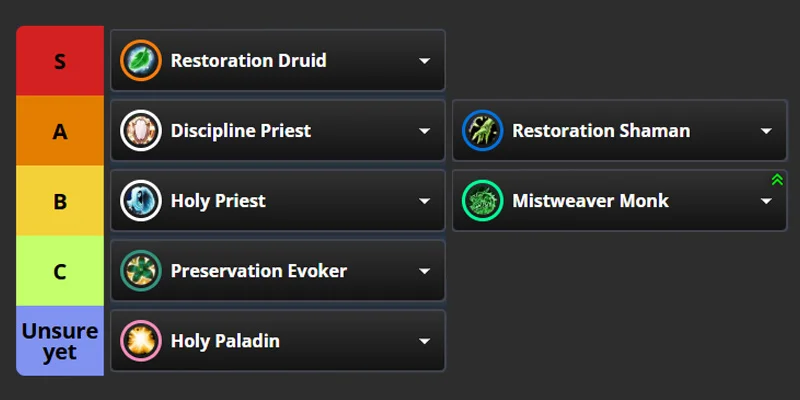
Tier List Overview
| Tier | Specializations |
|---|---|
| S Tier | Restoration Druid |
| A Tier | Restoration Shaman, Holy Paladin, Discipline Priest |
| B Tier | Holy Priest, Mistweaver Monk |
| C Tier | Preservation Evoker |
A few notes on reading this list: S Tier means the spec is the clear best healer and a defining part of the meta. A Tier specs are strong, viable picks that bring real strengths to any group. B Tier specs can get the job done but have notable weaknesses holding them back from competing with higher-ranked options. C Tier means the spec is underperforming in multiple areas and needs buffs or a rework to become competitive.
Restoration Druid
Resto Druid enters Midnight Season 1 as the strongest healer by a wide margin. No other healing spec comes close to its mix of sustained healing throughput, crowd control, utility, and mana efficiency. If you're looking for the single safest healer pick for Season 1, this is it.
Why Restoration Druid Dominates
Healing throughput is unmatched. Resto Druid's sustained HPS is far ahead of every other healer on the beta right now. The spec keeps the entire party healthy through layered healing-over-time effects that synergize with its Mastery (Harmony), which increases all your healing based on how many HoTs are active on a target. More HoTs means harder-hitting individual heals, creating a snowball effect that other healers just can't replicate.
The Apex talent is a game-changer. Resto Druid's Apex talent creates a powerful loop: casting Swiftmend activates Soul of the Forest, and spending that buff on Regrowth or Rejuvenation causes your Lifebloom to continuously bloom onto a single target. This gives you a roughly 15-second window of massive single-target healing, which is critical for Midnight's dungeon pool. A lot of Season 1 dungeons throw heavy priority-target healing at you: heal absorbs, bleeds, DoTs, and ticking damage that require you to rapidly top up a specific player. With this mechanic, you can park a Lifebloom on whoever's in danger, let it carry much of the heavy lifting, and move it to a new target every 15 seconds as needed. Extra healing also splashes onto nearby allies, boosting your group-wide output on top of it.
You don't live and die by your cooldowns. Unlike many healers on this list who feel godlike with cooldowns up but weak without them, Resto Druid isn't heavily cooldown-dependent. You can pump out high healing just by setting up HoTs quickly and letting Mastery amplify everything. Tranquility is still a very powerful direct healing cooldown (it no longer has a HoT attached, it just pulses direct healing now). Convoke the Spirits is still there to spread HoTs fast when you need burst group healing. But the real strength is that you don't need these cooldowns for every dangerous boss fight or trash pull. You just need to know when the damage is coming and prepare your HoTs beforehand.
Best crowd control among healers. After Midnight's talent pruning, Resto Druid still has one of the strongest CC toolkits of any healer: Disorienting Roar (AoE disorient), Typhoon (AoE knockback), and Ursol's Vortex (AoE pull/slow). This combo gives you flexible tools for helping your tank kite, disrupting dangerous casts, and controlling trash packs.
Strong utility package. Mark of the Wild provides a flat 3% Versatility buff to the entire party, and that's always valuable for pushing higher keys since Versatility gives both damage and damage reduction. Beyond that, Resto Druid brings a well-rounded toolkit of external defensives, mana sustain, group mobility, dispels, and enrage removal. See the full utility breakdown below.
Mana efficiency is excellent. Druid's mana management feels very comfortable on the beta, meaning you can sustain high output through long pulls and boss fights without running dry.
Highest healer damage. No healer in Midnight is doing spectacular damage, but Resto Druid puts out more personal DPS than any other healing spec. It's a small edge, not a deciding factor, but worth knowing about.
Recent Nerfs and Current Standing
Blizzard has specifically targeted Resto Druid with nerfs aimed at reducing its dungeon power while keeping raid performance stable. These included a 20% reduction to Mastery (Harmony) effectiveness, reduced critical healing from the Intensity talent (75% down to 60%), nerfs to Regrowth direct healing, and Wild Growth adjustments. On the flip side, Matted Fur got buffed, Wild Growth healing went up, and several raid-oriented talents were improved.
Even after all of that, testing confirms Resto Druid is still extremely strong. Max HPS, mana efficiency, crowd control, utility: everything is still well above other healers. At most, these nerfs might knock one key level off the spec's ceiling compared to before, which is negligible given how far ahead it already was. If you were planning to main Resto Druid for Mythic Plus, nothing here changes that decision.
Utility Breakdown
- Mark of the Wild - 3% Versatility to the party (always active)
- Ironbark - Short-cooldown external damage reduction
- Innervate - 8 seconds of mana-free casting (always self-cast in dungeons since you're the only healer)
- Stampeding Roar - 60% movement speed to all party members for 8 seconds
- Remove Corruption - Removes Curse and Poison effects
- Soothe - Dispels Enrage effects from enemies
- Disorienting Roar / Mighty Bash - Choice between AoE disorient or single-target stun
- Typhoon - AoE knockback
- Mass Entanglement / Ursol's Vortex - Choice between AoE root or AoE vortex that pulls enemies to one location
Restoration Shaman
Resto Shaman is the strongest healer option for groups running physical damage compositions, largely thanks to Skyfury. It brings an interrupt (the only healer with one in Midnight), powerful cooldowns, and solid utility. The downside is that you feel noticeably weaker outside of your major healing cooldowns, and the gameplay can feel a bit empty after the talent pruning.
Strengths
Skyfury is the best M+ party buff among healers. Skyfury provides additional Mastery and auto-attack value to your group, making it extremely powerful for physical damage comps. If your group is melee-heavy or running physical-focused DPS, Shaman's buff alone can justify the healer spot.
The only healer with an interrupt. Resto Shaman keeps Wind Shear in Midnight, making it the only healing spec with an interrupt. It's on a 30-second cooldown instead of the standard 12-second DPS kick, but a backup interrupt is always valuable. Blizzard has cut down on interrupt requirements in Midnight dungeons overall, but having that extra kick still matters in tight situations.
Powerful healing cooldowns. Ascendance is one of the most ridiculous healing cooldowns in the game right now. While active, your Healing Wave always crits and then hits a second time for 50% value, basically giving you a full-strength Healing Wave plus a crit Healing Wave every cast. During Ascendance, you can chain Riptide into Healing Wave over and over: each Riptide makes your next Healing Wave instant cast and applies another Riptide to the target. This creates a rapid cycle of Riptide, Healing Wave, Riptide, Healing Wave that generates enormous throughput, and Ascendance cleaves all of it to additional allies.
Spirit Link Totem provides 10% party-wide damage reduction with health redistribution, and it remains one of the best defensive cooldowns in the game for saving a group from dangerous burst damage.
Strong priority-target healing. Single-target healing feels solid. Between empowered Healing Waves, Riptide maintenance, and the ability to turret-heal a single target, you can reliably keep individual party members alive through focused damage.
Lots of passive healing output. A big chunk of Resto Shaman's healing comes from passive sources, especially through the Apex talent (Stormkeeper Totem, which empowers your Healing Stream Totem after activating Nature's Swiftness or Ancestral Swiftness). This passive healing baseline makes preparation easier. If you know when the big damage is coming, you can pre-place totems and hold Ancestral Swiftness for the right moment.
Good survivability. Personal tankiness feels solid on the beta, giving you enough durability to handle incidental damage without blowing globals on yourself.
Weaknesses
Heavily cooldown-dependent. This is the spec's biggest problem. When Ascendance and Spirit Link are up, you feel nearly unstoppable. When they aren't, your output drops significantly and you're mostly stuck turret-healing single targets with Healing Wave. You can't just burn mana to push out more healing the way some other specs can. Casting more Chain Heals doesn't meaningfully increase your output, and you'll basically never run OOM, but you also can't convert that extra mana into emergency healing during cooldown gaps.
Chain Heal and Healing Rain feel weak. Both of these iconic Shaman abilities feel bad to press right now. Chain Heal doesn't provide enough throughput to justify its cast time in most scenarios, and Healing Rain similarly underperforms. This leaves a real hole in your AoE healing toolkit outside of cooldowns.
Gameplay feels pruned. After Midnight's talent changes, a lot of Shaman players feel like there just aren't enough buttons to press meaningfully. The gameplay loop can feel hollow outside of cooldown windows. This is subjective, but it's a widely reported concern.
Lost knockback. Resto Shaman no longer has its knockback ability, leaving Capacitor Totem (AoE stun) as the main CC tool alongside Poison Cleansing Totem for niche dispel situations.
Utility Breakdown
- Skyfury - Party-wide Mastery and auto-attack buff
- Bloodlust / Heroism - Combat haste cooldown
- Earth Elemental - Powerful defensive summon that can tank non-boss enemies
- Spirit Link Totem - 10% damage reduction and health redistribution within 10 yards
- Capacitor Totem - AoE stun
- Wind Shear - 30-second interrupt (only healer with one)
- Wind Rush Totem - Group movement speed increase (can be talented to also remove snares)
- Cleanse Spirit - Removes Curse effects
- Purge - Removes 1 beneficial Magic effect from an enemy
- Poison Cleansing Totem - Removes poison effects on nearby party members
- Ancestral Vigor - Core abilities temporarily increase target health by 10%
- Elemental Resistance - Small group-wide magical damage reduction
Holy Paladin
Holy Paladin enters Midnight with a distinct healing identity built around managing multiple single-target healing spells with different mana costs and throughput levels. After several rounds of buffs (following initial nerfs that were later reverted), Holy Paladin is a solid A Tier healer with particularly enjoyable gameplay for players who like active decision-making.
Strengths
Excellent healing output. Holy Paladin's raw throughput is strong. Your core gameplay revolves around weaving between four main healing tools: Holy Light (expensive, high healing), Flash of Light (cheap, low healing, builds Holy Power), Holy Shock (Holy Power builder, moderate healing), and Eternal Flame (Holy Power spender, single-target HoT). This creates a satisfying rhythm of generating and spending Holy Power while managing your mana budget based on the damage profile of each pull.
Active mana regeneration. Unlike most healers who just watch their mana bar slowly drain, Holy Paladin has active ways to regen mana during gameplay. This turns mana management into an engaging mechanic rather than a passive limitation.
The Apex talent (Traveling Beacon) adds smart healing. Your new Apex talent creates a beacon that automatically travels to allies in need, jumping to low-health targets or moving to a new target once the current one is fully healed. The beacon target gets a small absorb shield, some damage reduction, and increased healing received. This adds another layer of decision-making: you want to keep an eye on which ally has the beacon and focus healing on them to get the most out of the effect. Running double beacon (instead of Beacon of Virtue) has proven especially effective since it removes a global from your rotation and saves significant mana. Virtue is expensive, and that mana is better kept in reserve.
Powerful emergency healing. When things go sideways, you can lean hard into Holy Light, your most expensive but highest-throughput heal, to muscle through incoming damage. This gives Paladin a unique "emergency gear" that other healers lack: you can burn mana fast for massive healing output when you absolutely need to save the group, at the cost of your mana pool.
Strong utility and defensives. Holy Paladin's utility is among the best in the game: permanent group-wide damage reduction, a full health restore, multiple targeted blessings for allies in danger, and a combat resurrection. See the full utility breakdown below for details.
Good personal tankiness. You're fairly tanky on your own without spending excessive globals healing yourself.
Light of Dawn improvements. Light of Dawn now caps at 5 targets and does a reasonable job with rot damage (sustained ticking damage spread across the party), especially on fights with even damage distribution. Free Light of Dawn procs from Imperial Legacy add meaningful AoE healing on top of your primarily single-target kit.

Weaknesses
Mana is a real constraint. Active mana regen is a strength, but mana is still tight. Holy Light is extremely expensive, and leaning on it too heavily will drain you fast. The core skill challenge of the spec is managing the balance between mana-efficient healing (Flash of Light, Holy Shock) and high-throughput healing (Holy Light).
No strong damage-boosting party buff. Unlike Resto Druid (Mark of the Wild) or Resto Shaman (Skyfury), Holy Paladin doesn't bring a buff that significantly increases party damage. This puts you at a disadvantage when competing for a healer spot in groups that are min-maxing their damage output.
May struggle at the absolute highest key levels. The mana-heavy playstyle and lack of a damage-boosting group buff suggest Holy Paladin may not be the optimal pick for the very highest key tiers where groups need maximum efficiency. For the vast majority of players, though, this won't matter.
Utility Breakdown
- Devotion Aura - Permanent 3% group-wide damage reduction
- Aura Mastery - Amplifies your active aura for the group
- Lay on Hands - Heals a party member to full health
- Intercession - Combat resurrection
- Hammer of Justice - Single-target stun
- Blessing of Sacrifice - Transfers damage from a target to yourself (can be talented for improved effectiveness)
- Blessing of Protection - Physical damage immunity for a target
- Blessing of Freedom - Immunity to movement-impairing effects
- Cleanse Toxins - Removes Poison and Disease effects
- Turn Evil - Fear effect on Undead, Aberration, or Demon targets
Discipline Priest
Discipline Priest has been one of the most talked-about healers throughout the Midnight beta, and not always for good reasons. The spec brings a unique and powerful toolkit: damage reduction, absorb shields, Power Infusion, and a distinctive Atonement-based healing style. But it's also been hit with four rounds of nerfs during beta testing, and the cumulative damage is starting to show. Discipline stays in A Tier thanks to its toolkit, but it sits at the lower end with real concerns about where it's heading.
Strengths
Unique and powerful toolkit. Disc Priest brings a combination of tools that no other healer can match: a significant DPS damage buff, group-wide Stamina, a powerful single-target damage reduction external, mass dispelling, aggro range reduction for trash skips, and an AoE disorient. This utility package alone makes Discipline highly desirable for organized groups. See the full utility breakdown below for details.
Absorb shields smooth out incoming damage. The Apex talent Void Shield creates powerful Power Word: Shield effects that hit three targets at once. Regular shields absorb roughly 15-20% of a player's health bar, while Void Shield procs push that to 20-30%. This makes squishy DPS players noticeably tankier and helps smooth out incoming damage spikes.
Oracle hero talents give you strong burst healing. Oracle is the clear best hero talent choice for Discipline. It grants double charges of Penance, and Twin Sight causes your Penance to simultaneously hit an enemy and heal an ally. These penance windows are the core of your throughput and feel really good when timed well.
Evangelism revamp adds burst AoE healing. The reworked Evangelism instantly applies five Atonements by casting Radiance, then makes your next two Radiances instant cast. Pair this with the Archangel talent (increased healing and absorbs for 18 seconds on a 1.5-minute cooldown) and you've got strong burst windows for handling dangerous AoE damage.
Ultimate Penitence is powerful on bosses. On single-target boss fights, Ultimate Penitence fires a barrage of bolts into one enemy. With the Searing Light talent, this stacks up a significant damage-over-time effect that heals allies through Atonement the entire time. While channeling, you also get a full health bar worth of absorb shield, making you basically immune to damage. After it ends, you've still got 8 seconds of the stacking DoT ticking, and your Penance charges will be back up quickly thanks to the low cooldown.
Damage reduction is always valuable. Between Pain Suppression, Lenience (passive damage reduction from Atonement), and the option to spec into Power Word: Barrier, Discipline provides layered damage reduction that only gets more valuable as key levels rise.
Weaknesses
Four rounds of nerfs are adding up. This is the big concern. Discipline has been nerfed repeatedly throughout beta. Prompt Prognosis (which made your first Penance bolt do extra damage/healing) was cut from 200% to 125%. Prophet's Insight reduced Atonement healing from Holy spells. Preventive Measures got nerfed for Oracle. Searing Light dropped from 30% to 20%. All of this adds up: your Atonement-based healing from Smite and Penance feels noticeably weaker than it did earlier in the beta cycle.
Smite feels bad. Smite damage is underwhelming, and since Smite drives your Atonement healing during low-to-moderate damage periods, your baseline healing contribution outside burst windows feels weak. This also tanks the Voidweaver hero talent path, since Void Blast inherits Smite's underwhelming base. Blizzard has tried buffing Voidweaver through increased tick damage (Entropic Rift) and explosion damage (Collapsing Void), but these changes haven't been enough. Voidweaver also used to work well with Shadow Covenant to amplify your abilities, and that's gone now.
Void Shield is eating too much of your healing profile. An unintended consequence of the repeated Atonement nerfs is that Void Shield absorbs now make up a disproportionate chunk of your total healing. That's not healthy design. You don't want a single talent to feel mandatory and overpowered while your entire core mechanic (Atonement healing) falls behind.
More cooldown-dependent than before. After four rounds of nerfs, your healing is even more tied to your Penance double charges, Evangelism/Archangel windows, and Ultimate Penitence. Between these cooldowns, you're relying on Void Shield procs and Flash Heal (which burns mana) to handle damage. How you time your cooldowns around Pain Suppression, player defensives, and incoming damage patterns matters a lot more now than it did a few weeks ago.
Limited crowd control. Discipline's CC is limited to a single Psychic Scream (AoE fear). That's notably less than Resto Druid or Resto Shaman.
Five-man Atonement modifier changed. The previous clear bonus to Atonement healing in smaller groups has been replaced with a vague "does more healing at lower Atonement counts" modifier without specific numbers. The output feels weaker as a result.
Utility Breakdown
- Pain Suppression - 40% damage reduction external on a chosen target
- Power Word: Barrier - Group-wide 20% damage reduction in an area (talent choice vs. Ultimate Penitence)
- Power Infusion - Significant damage buff to a chosen ally (requires Twins of the Sun Priestess to also buff yourself)
- Power Word: Fortitude - 5% Stamina raid-wide buff
- Psychic Scream - AoE disorient
- Mind Soothe - Reduces enemy aggro range for skips
- Mass Dispel - AoE dispel (extremely valuable in specific dungeons)
- Dominate Mind - Mind control an enemy while maintaining your rotation
- Shackle Undead - 50-second crowd control on Undead targets
- Purify Disease - Removes Disease effects (in addition to Dispel Magic)
Holy Priest
Holy Priest is in a strange spot for Midnight Season 1. Its raw healing output is genuinely impressive, possibly the best burst AoE healing of any healer when cooldowns are up. Two critical weaknesses (survivability and mana efficiency) keep it from competing with A Tier specs, though. It's received two flat healing buffs during beta (10% and 8%), but neither addresses the spec's actual problems.
Strengths
Burst AoE healing is phenomenal. Archon Holy Priest, the dominant build, creates an incredibly satisfying burst healing loop. Here's how the core interaction works: Halo (expanding and contracting AoE) generates lots of Surge of Light procs. The Spirit Well talent lets you spend Surge of Light on Prayer of Healing (normally it only works with Flash Heal). At the same time, the Lightweaver talent causes your Flash Heals to buff your next Prayer of Healing. So you're building stacks from two sources: Surge of Light makes Prayer of Healing cheaper and instant, while Lightweaver makes it hit harder.
On top of this, Ultimate Serenity lets you give up Sanctify in exchange for a stronger Holy Word: Serenity (your big single-target Holy Word) that also cleaves healing to all allies. Prayer of Healing reduces Serenity's cooldown too, creating a powerful cycle: cast buffed Prayer of Healing for AoE healing, reduce Serenity's cooldown, cast Serenity for single-target burst plus AoE cleave, repeat.
When Apotheosis is active, the Divinity talent makes both Flash Heals and Prayer of Healing instant cast, turning you into an absolute healing machine for the duration. The result is some of the highest burst AoE healing in the game when your cooldowns and stacks line up.
Strong single-target healing. Holy Word: Serenity hits hard, especially with Ultimate Serenity talented. Between Serenity, Flash Heal, and your HoTs, you can handle priority-target healing well when you have the resources.
Brings Power Infusion. Like Discipline, Holy Priest brings Power Infusion to buff a DPS player's damage, plus Power Word: Fortitude for the 5% Stamina group buff.
Fun, engaging gameplay. A lot of players are calling this potentially the most fun Holy Priest has been in years. The interplay between Surge of Light procs, Lightweaver stacks, Divinity, and your Holy Words creates genuine depth and decision-making. If you enjoy thinking about cooldown sequencing and resource management, you'll love this.

Weaknesses
The squishiest healer in the game. This is Holy Priest's biggest flaw, full stop. Your defensive toolkit is the worst of any healer in Midnight, and it's not even close. Your options are Fade, a Flash Heal for Protective Light, and a health increase from Desperate Prayer. All of them feel insufficient. You end up spending way more globals healing yourself than other healers do, which directly eats into time you could spend healing your party or dealing damage. In practice, if you want to push higher keys as Holy Priest, you'd basically need a full Versatility set just to survive. Without that passive damage reduction, you'll be using your free Restitution resurrection on cooldown every 10 minutes.
Mana efficiency is a serious problem. Holy Priest burns through mana quickly, especially when casting Prayer of Healing. Surge of Light procs help by making some casts cheaper (they're 50% off now, no longer fully free), but generating those procs requires casting Smite during downtime, and Smite feels terrible for Holy Priest. Unlike Holy Paladin, you have no active mana regeneration mechanic (Symbol of Hope is gone). Flash Heal during downtime still drains mana. You're constantly fighting a losing battle against your mana bar.
Cooldown-dependent. Holy Priest feels extremely powerful when Apotheosis and your stacks line up, but weaker when you lack Lightweaver stacks, Surge of Light procs, and Divinity. Recovering from damage without your setup ready is significantly harder.
No real defensive contribution to the group. Beyond Guardian Spirit (a single-target cheat death), Holy Priest doesn't bring meaningful damage reduction for the group. Compare that to Discipline's Pain Suppression plus Barrier plus Lenience, or Paladin's Devotion Aura plus Aura Mastery plus Blessings.
The healing buffs don't address core issues. The 10% and 8% flat healing buffs are welcome, but they don't fix the survivability or mana problems. The spec needs either better defensives, a mana-efficient regeneration tool, or both to move up.
Utility Breakdown
- Guardian Spirit - Single-target cheat death for a chosen player
- Holy Word: Chastise - Single-target disorient
- Power Infusion - Damage buff (requires Twins of the Sun Priestess)
- Power Word: Fortitude - 5% Stamina raid-wide buff
- Mind Soothe - Reduces enemy aggro range for skips
- Mass Dispel - AoE dispel
- Dominate Mind - Mind control an enemy
- Shackle Undead - 50-second Undead crowd control
- Purify Disease - Disease removal (in addition to Dispel Magic)
Mistweaver Monk
Mistweaver Monk has been on a rollercoaster throughout the Midnight beta. Initially sitting in C Tier, significant buffs and build discoveries have moved it up to low B Tier. Sustained healing has gotten notably better, but the spec still struggles to find a real spot in the meta because of limited group synergy and underwhelming external cooldowns.
Strengths
Decent sustained healing for rot damage. After buffs to Jadefire Teachings (Ancient Teachings healing increased to 260%, up from 180%) and Way of the Crane (damage transfer increased to 160%, up from 120%), Mistweaver handles sustained ticking damage much better than before. With Renewing Mist spread across the party and the Mistline talent providing consistent passive output, the spec can maintain a solid healing baseline during rot scenarios. Testing on dungeons with heavy rot damage, like the final boss of Windrunner Spire, showed the spec handling sustained damage effectively.
Improved build options. Running Conduit of the Celestials with Mistline, combined with Jade Bond instead of the one-minute cooldown setup, and using Sheilun's Gift with Shaohao's Lessons, has produced significantly better results than earlier builds.
Mana Tea provides mana management. Mana Tea helps control mana consumption, and the Jade Bond build has better mana efficiency than earlier setups.
Raw HPS is respectable. Pure healing throughput is decent. You can keep your party alive through most damage patterns if you play well. Mistweaver doesn't fail on raw healing numbers.
Weaknesses
Worst external defensive cooldowns of any healer. This is consistently Mistweaver's most damaging weakness. Life Cocoon, your main external, applies a large absorb shield to a target, but in practice it often gets eaten almost immediately by incoming damage. It essentially just buys you a few seconds to start healing the target again. Compare that to Pain Suppression (40% damage reduction), Guardian Spirit (cheat death), or Ironbark (direct damage reduction), all of which feel far more impactful. Not being able to provide meaningful external damage reduction makes Mistweaver a weaker partner for tanks and squishy DPS in high-key environments.
No interrupt. Mistweaver lost its interrupt going into Midnight. Blizzard has reduced interrupt requirements in the new dungeons, but one fewer kick in the group is still a real disadvantage.
Physical vulnerability buff has limited meta value. Mystic Touch gives 5% extra Physical damage for the party, but the Midnight meta is trending toward magical/caster compositions. That means Mistweaver's party buff is less valuable than Mark of the Wild, Skyfury, or Power Infusion in the comps most groups are actually running. Mistweaver fits best in physical compositions, but even there, Brewmaster Monk already provides Mystic Touch, reducing the need for a Mistweaver healer.
Healing cooldowns feel underwhelming on their own. Revival is a decent cooldown, but your Celestials, Chi-Ji, and other healing cooldowns don't individually put out enough. You often end up stacking multiple cooldowns on top of each other just to handle major damage events, which leaves you exposed when they're all on cooldown at the same time.
Damage contribution is minimal. Personal damage output is low, and the spec doesn't feel rewarding for doing a good damage rotation in dungeons. Ancient Teachings healing from damage dealt doesn't feel impactful enough to justify the globals spent on DPS.
Bug issues throughout beta. Mistweaver has had numerous bugs during the beta, some suppressing the spec's performance, others inflating it (like Jade Empowerment dealing more damage than intended). The true power level has been hard to pin down.
Utility Breakdown
- Mystic Touch - 5% extra Physical damage for the party
- Life Cocoon - Large absorb shield on a friendly target
- Revival - AoE dispel removing Magic, Poison, and Disease from the party
- Leg Sweep - 3-second AoE stun
- Tiger's Lust - Removes roots and snares from a target
- Ring of Peace - AoE knockback/displacement (useful for tank kiting and as a disorient)
- Detox - Removes Poison and Disease effects
- Paralysis - Single-target disorient and Enrage dispel
Preservation Evoker
Preservation Evoker sits at the bottom of the healer tier list for Midnight Season 1. Despite ongoing adjustments throughout the beta and arguably the heaviest pruning of any healer going into the expansion, the spec hasn't found a competitive footing in Mythic Plus. It underperforms in multiple areas at once, making it one of the least represented healers in the current meta.
Strengths
Strong prepared burst AoE healing. When Preservation has time to set up and knows exactly when damage is coming, it can produce impressive group healing. Echo lets you replicate abilities like Dream Breath, and stacking modifiers like Grace Period (increased healing to targets with Reversion) can create large healing windows. Rewind (rewinding 33% of damage taken by all allies in the last 5 seconds) remains a powerful situational cooldown. Double Time Dilation charges are a welcome addition too, giving you more flexibility in extending your healing effects.
Good personal tankiness. Preservation's personal survivability is solid. You have good defensive resources to keep yourself alive, which is more than can be said for Holy Priest.
Broad dispel utility. Cauterizing Flame for bleed removal, Expunge for poison removal, and the broader Evoker toolkit give you niche dispel coverage that has value in specific dungeons.
Bloodlust access. Bringing your own Bloodlust/Heroism is always useful for group composition flexibility.
Weaknesses
Healing throughput is inconsistent. When everything is set up perfectly, Preservation can heal well. When players are spread out, when you get caught off-guard, or when damage patterns don't line up with your setup windows, your healing drops off hard. The spec has a higher setup requirement than any other healer, and that setup is frequently disrupted by the realities of dungeon gameplay.
Priority-target healing is weak. This is one of Preservation's biggest problems given the Midnight dungeon pool. A lot of dungeons feature heavy heal absorbs, targeted bleeds, and DoTs that demand you rapidly top up a specific player. Your tools for this are limited: Verdant Embrace serves as a priority heal, and you can save up Life Spark stacks for Living Flame single-target heals, but holding onto these resources feels awkward and leaves you underperforming in the meantime. Things like Magister's Terrace with heavy heal absorbs feel stressful to deal with on this spec. Compared to Resto Druid's Lifebloom Apex talent or Paladin's Holy Light for single-target emergencies, Preservation's tools feel inadequate.
Positional requirements are punishing. Dream Breath has been extended to 40-yard range, but it still needs your party to be relatively stacked for effective healing. A lot of Midnight dungeons feature wide-open arenas and spread-out positioning that work against this. And there are also some wide arenas and rooms where ranged DPS naturally spread, and forcing them to stack for your healing is a coordination burden other healers don't impose.
The raid buff hurts the spec. Blessing of the Bronze is widely considered the least impactful healer buff for Mythic Plus. Compared to Mark of the Wild, Skyfury, Power Word: Fortitude, or Mystic Touch, it provides less meaningful group benefit.
Lost key tools in pruning. Preservation lost Emerald Communion as an additional healing cooldown and can no longer Echo Lifebind, both of which were important. Spirit Bloom has been rolled into the Apex talent (now called Marithra's Blessing, activated by casting Reversion), but the replacement doesn't fully cover the healing gap left by these losses.
Damage contribution isn't impressive. Healer damage is low across the board in Midnight, and Preservation doesn't stand out here either.
Utility Breakdown
- Blessing of the Bronze - Party buff (least impactful healer buff for M+)
- Rewind - Rewinds 33% of damage taken by all allies in the last 5 seconds
- Wing Buffet - Pushback
- Expunge - Removes Poison effects from an ally
- Cauterizing Flame - Bleed removal
- Sleep Walk - Single-target crowd control (forces enemy to walk toward you)
- Source of Magic - Mana support (can be improved with Potent Mana talent)
- Oppressing Roar - Increases crowd control duration on affected enemies by 50% (can be talented for AoE Enrage removal via Overawe)
- Zephyr - AoE damage reduction for the party
- Rescue - Displacement ability to reposition an ally

Picking Your Healer
If You Want the Strongest Option
Play Restoration Druid. There's a significant gap between Resto Druid and everything else. It's the safest, most versatile, and highest-performing option at all key levels.
If You Want a Strong Pick With Good Utility
Restoration Shaman works if your group runs physical damage comps and you want the best party buff (Skyfury) plus an interrupt. Discipline Priest fits if you value the Power Infusion buff, damage reduction externals, and absorb shield playstyle. Holy Paladin is the call if you enjoy active, decision-heavy healing with strong emergency output and excellent utility.
If You Love Your Spec Regardless of Meta
Holy Priest delivers some of the most satisfying burst healing gameplay in the game if you can manage the survivability and mana challenges. Mistweaver Monk has improved significantly and handles rot damage well, especially in physical comps. Both specs require more effort to achieve results that A Tier healers deliver more comfortably.
What to Avoid Unless You're a Dedicated Main
Preservation Evoker is underperforming in Mythic Plus and needs significant changes to become competitive. Play it in raids where its strengths are more relevant, or wait for buffs before committing to it for M+ content.
Group Composition
The healer meta is shaped by what DPS and tank compositions are popular. Right now, there's support for both physical and magical damage group compositions:
Physical comps favor Restoration Shaman (Skyfury buff) or Mistweaver Monk (Mystic Touch, though redundant with Brewmaster), paired with melee DPS and physical-focused tanks.
Magical comps favor Discipline Priest (Power Infusion) or Holy Paladin (Devotion Aura), paired with caster DPS.
Restoration Druid fits into any composition thanks to its versatile toolkit and Mark of the Wild.
This tier list will be updated weekly as new beta changes arrive. Check back regularly for the latest healer rankings heading into Midnight Season 1.