

Warlocks in TBC Classic are among the most powerful and utility-rich DPS classes in the game. Masters of demonic energy and dark magic, they summon demons, place curses, and channel devastating bursts of shadow and fire. Their toolkit goes well beyond raw damage, and spells like Ritual of Summoning and Create Soulstone let Warlocks do things no other class can, making them a welcome addition to any group or raid.
This guide covers the Demonology specialization specifically, the pet-focused build that leans heavily on its demon companion to deal damage. Demonology lands in the middle of the three Warlock specs in terms of both DPS and complexity. You'll manage fewer DoTs than an Affliction Warlock, but you'll need to actively manage and protect your Felguard, which drives a significant chunk of your total damage. On fights with heavy movement, crowd control, or frequent interrupts, Demonology can actually surpass Destruction, because your Felguard keeps attacking even when you're forced to move or can't cast.
Demonology isn't the most common Warlock spec in raids, and beyond the early gearing phase at Level 70, it doesn't carve out as clear a niche as Destruction or Affliction in most compositions. It's still fully viable and enjoyable to play, with a strong identity and real advantages in specific fights. It also shines during leveling, making it a great choice for players working their way to max level.

What Makes Warlocks Unique
Before getting into the Demonology-specific details, it helps to understand what sets Warlocks apart as a class. Warlocks channel Fel magic, a force that draws on life and death itself, and many of their spells literally consume the caster's own health as a resource. This creates a distinctive self-management rhythm that other caster classes don't share.
A core resource for Warlocks is the Soul Shard. You capture these from enemies by using Drain Soul as they die. Soul Shards are stored in your bags and consumed by many commonly-used abilities, so keeping your supply stocked is an ongoing responsibility that requires planning before and during raid encounters.
Warlocks also bring exclusive consumables that no other class can provide: Master Healthstone, which functions as a powerful healing item, and Master Soulstone, which allows a raid member to self-resurrect on death. These tools alone make Warlocks a welcome addition to any composition regardless of their damage numbers.
Curses add another layer of class utility. Curse of the Elements reduces a target's shadow and arcane resistance while amplifying damage from those schools, which is a meaningful benefit in caster-heavy raids. In TBC, this curse was expanded to cover both shadow and arcane resistance, so you no longer need to apply the old Curse of Shadow separately.
Fear and Banish give you real crowd control options, and Ritual of Summoning lets you teleport group members directly to your location, saving time during raid pulls and dungeon runs.
Strengths and Weaknesses
Knowing what Demonology does well and where it struggles lets you set realistic expectations and make smarter decisions during play.
- Solid damage in both single-target and AoE situations. The Felguard contributes meaningfully to your total output across encounter types, and Seed of Corruption remains one of the strongest AoE spells in the game, available to all Warlock specs.
- High survivability. Compared to other ranged DPS, Demonology Warlocks are notably tanky. Drain Life and Siphon Life provide real self-sustain during fights, letting you recover health without constantly pulling healer attention.
- Effectively unlimited mana. Life Tap converts health into mana, so you'll never run dry during a fight. Combined with Drain Life and Siphon Life keeping your health topped off, this creates a self-sufficient cycle that most casters simply don't have.
- Predictable gearing in early phases. A large portion of your BiS and Pre-Raid gear comes from crafted Tailoring sets, which you can work toward without competing against other players for drops. This makes early gearing more consistent compared to specs that rely heavily on raid loot.
- Full class utility. All Warlocks bring Curses, Healthstones, Soulstones, Fear, and Banish. These tools stay relevant throughout every phase of TBC Classic.
- Your pet keeps dealing damage when you can't. This is Demonology's most distinctive advantage. On fights like Magtheridon and Gruul in Phase 1, where the Warlock is frequently unable to cast, the Felguard keeps attacking the target. It also takes 50% reduced damage from boss AoE spells and automatically positions itself behind targets when possible, since bosses can't parry or block attacks from behind, which boosts both its survivability and its damage output.
- Severe threat issues. Warlocks have always struggled with generating too much threat, and TBC doesn't fix this. Managing your threat output, especially at the start of encounters, is a constant concern. Soulshatter drops your total accumulated threat by 50% on a long cooldown, which helps, but it doesn't solve the underlying problem.
- No movement abilities. Warlocks have no movement speed boosts, and most spells require you to stand still. Your personal damage suffers significantly on fights with a lot of movement. The Felguard's continued damage during those phases partially offsets this, which is part of why Demonology performs better on movement-heavy fights than the other specs.
- Hard casting is mandatory. You'll be casting almost every spell the standard way, with no significant instant-cast windows to cover gaps when you need to move.
- Soul Shards require active farming. Keeping your supply ready before raids takes time and planning outside of raid hours.
- Expensive initial gearing. Crafted Tailoring gear makes up a large portion of your early BiS list. The reduced competition for drops is a genuine advantage, but the raw crafting costs can be steep at the start of the expansion.
- Low-button rotation. The rotation is mechanically simple. Some players find this freeing since it leaves more attention for raid mechanics. Others find it repetitive. It's worth knowing before you commit to the spec.
Viability in TBC Classic
Demonology isn't the dominant Warlock spec in raids. Fire Destruction Warlocks, particularly when paired with a Fire Mage providing the Improved Scorch debuff, tend to top DPS charts. Affliction fills a unique utility slot with Malediction and Shadow Embrace, so most raids want at least one. Demonology sits between the two, capable of competitive damage but without a strictly exclusive niche in most compositions.
In the right situations, Demonology genuinely pulls ahead. Fights with heavy movement requirements, extended phases where casters can't act, or frequent interrupts and CC play directly to its strengths. Magtheridon and Gruul in Phase 1 are clear examples where Demonology can outperform the other specs because the Felguard doesn't stop dealing damage when the encounter gets chaotic.
For players who enjoy the pet management playstyle and want a spec that rewards preparation and awareness, Demonology holds its own in a raid environment.
Best Race
Race choice in TBC Classic has a real but not dramatic impact on performance. Picking a suboptimal race won't hold you back from clearing content, but for players who want every bit of DPS accounted for, the choices below are the ones to aim for.
Alliance
Gnome is the clear Alliance choice. Expansive Mind increases your Intellect by 5%, which raises both your maximum mana pool and your spell crit chance, a passive DPS gain that compounds throughout a fight. Escape Artist, a 2-minute cooldown that removes any root, snare, or slow, is excellent for PvP and occasionally comes up in PvE as well.
Human is the alternative, but it doesn't offer anything specifically useful for Warlocks. Diplomacy cuts down on reputation grinding time, and Perception has some PvP use, but neither moves the needle on DPS.
Horde
Orc is the top pick for PvE and the best overall option for Demonology. Blood Fury provides a significant burst of spell damage on a cooldown, and when stacked with other cooldowns and procs, it adds up to a meaningful DPS gain over a full fight. Command passively increases your pet's damage by 5%, which has direct synergy with a spec built around the Felguard. Hardiness, which reduces stun duration, is primarily useful in PvP.
Undead offers Will of the Forsaken, which removes Fear, Sleep, and Charm effects. It has occasional PvE applications but is mainly a PvP tool.
Blood Elf has Mana Tap and Arcane Torrent. At Level 70 in PvE, these don't provide meaningful advantages for Warlocks. Arcane Torrent is strong in PvP, but it won't improve your raid performance.
Talent Build
The standard Demonology Warlock talent build runs 1/41/19, with 41 points into Demonology to unlock and support Summon Felguard, 19 points in Destruction for complementary damage talents, and 1 point placed elsewhere.
Summon Felguard is the 41-point capstone talent and the reason you're playing this spec. It's the highest-damage demon available to any Warlock, and the surrounding talents in the Demonology tree focus on increasing your pet's damage output and survivability. Getting to and empowering the Felguard is the entire point of this investment.
These points go into talents that boost your personal damage output, including passive improvements to shadow and fire spell effectiveness and increased spell crit chance. They complement the Felguard's contribution rather than pulling the spec in a different direction.
The remaining 1 point is flexible and can go wherever it's most useful for your situation.
The talent distribution makes Demonology the middle-complexity Warlock spec. The rotation itself is simple, but playing it well means actively managing and protecting your pet throughout every encounter.

The Felguard
As a Demonology Warlock, you'll use the Felguard in all raid and PvE content. There's no alternative here. The Felguard is why you're playing Demonology, and it represents a major portion of your total damage output.
A few things that make the Felguard worth the investment:
- It's the highest-damage demon available to any Warlock.
- Intercept lets it close distance on targets quickly when needed.
- Cleave hits multiple nearby enemies simultaneously, adding real value on multi-target fights.
- It takes 50% reduced damage from boss AoE spells, which makes it far more durable than its health pool might suggest.
- It automatically positions behind targets when possible, so bosses can't parry or dodge its attacks.
In TBC Classic, demon pets also scale with their owner's stats, so every gear upgrade you earn improves the Felguard's performance too.
The most important skill as a Demonology Warlock is keeping the Felguard alive. If your pet dies mid-fight, your damage will drop sharply until it's back up and attacking again. Pet positioning, health monitoring, and knowing when to pull the Felguard back are the real mechanical challenges of playing Demonology at a high level.
Rotation and Abilities
Demonology's rotation is one of the simpler DPS rotations in TBC, which makes it accessible for players new to Warlock or those who prefer to focus their attention on raid mechanics rather than their action bars.
Single-Target Rotation
- Maintain your Curse. Apply and keep up whichever curse your raid needs. Curse of the Elements is the most common choice in raid settings, since it reduces the target's shadow and arcane resistance and boosts damage from those schools, benefiting every relevant caster in the group simultaneously.
- Maintain Corruption. Keep Corruption active at all times. It ticks consistently in the background and should never fall off.
- Maintain Immolate. Immolate is your second DoT to keep up on the target.
- Fill with Shadow Bolt. Once your Curse, Corruption, and Immolate are active, Shadow Bolt becomes your primary filler. You'll cast it repeatedly between refreshing your other spells.
Keep your DoTs and Curse up, then fill every remaining GCD with Shadow Bolt. The rotation doesn't change much from fight to fight, which is both the strength and the limitation of the spec.
AoE Rotation
- Cast Seed of Corruption on every target. Seed of Corruption is one of the strongest AoE spells in TBC. It has the highest AoE damage cap in the game, it can crit (and crits ignore the damage cap), it has a 15-yard explosion radius, and you can cast it from a safe distance. When three or more enemies are grouped together, this is your primary damage dealer.
- Add Hellfire if it's safe. If you're in range and the situation is stable enough, Hellfire adds additional AoE damage. It's situational and depends heavily on enemy positioning and whether you can stand still safely.
Stat Priority and Spell Hit Cap
Getting your stats right is how you turn good gear into great performance. For Demonology Warlocks, the priority order is:
Warlocks can only wear Cloth armor. For weapons, you can use Daggers, One-Handed Swords, or Staves in the main hand, with Held in Off-Hand items in the off-hand slot. Wands go in the ranged slot.
Best Professions
Profession choice has a real impact on your power level, especially in TBC's early phases. These are the top picks for Demonology Warlocks:
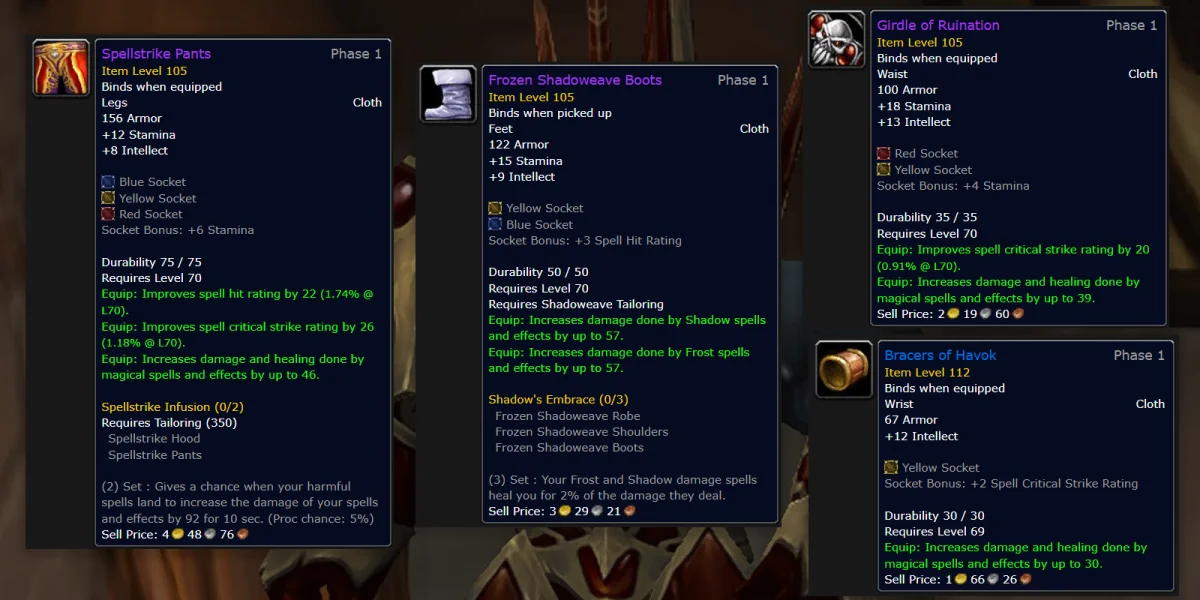
Tailoring is the must-have profession. A large portion of your Pre-Raid BiS and Phase 1 BiS gear comes from crafted Tailoring sets, some of which require a specific Tailoring specialization to equip, while others simply need Tailoring skill to access the set bonus. The early-expansion gearing advantage is substantial since you won't be competing against other players for these pieces, and some of them stay competitive for a long stretch of the expansion. Later phases introduce new crafted recipes as well, so the profession stays relevant as you progress.
Enchanting is the second-best profession for raw DPS gains. The exclusive perk is Enchant Ring - Spellpower, which you can apply to both rings for a total of 24 additional Spell Damage. No other profession touches your ring slots, which makes this bonus unique.
Engineering is a strong alternative or second profession. It gives you access to powerful consumable explosives like Super Sapper Charge, which is frequently used in PvE content, along with Adamantite Grenade. In Phase 2, Engineering-exclusive goggles become available and are considered exceptionally powerful for their tier, and these can be upgraded further in Phase 5. Engineering also provides exclusive flying mounts and the Zapthrottle Mote Extractor for harvesting valuable Motes. It pairs naturally with Mining as a supporting gathering profession.
Jewelcrafting is worth a mention. It lets you craft Epic gems before they're broadly available to other players, including Don Julio's Heart, which is the go-to caster gem in the early phases before hit gems become accessible. These gems are unique-equip though, meaning you can only have one of each equipped at a time, which limits the overall benefit compared to professions with stackable advantages.
Pre-Raid Best in Slot Gear
The gear below represents the best items to target before stepping into raid content. Much of it comes from crafted Tailoring, so you can start working toward these pieces immediately rather than waiting on raid drops.
| Slot | Item |
|---|---|
| Head | Spellstrike Hood |
| Shoulders | Frozen Shadoweave Shoulders |
| Chest | Frozen Shadoweave Robe |
| Wrists | Bracers of Havok |
| Hands | Manaspark Gloves |
| Waist | Girdle of Ruination |
| Legs | Spellstrike Pants |
| Feet | Frozen Shadoweave Boots |
| Neck | Brooch of Heightened Potential |
| Back | Sethekk Oracle Cloak |
| Ring | Ashyen's Gift |
| Ring | Sparking Arcanite Ring |
| Trinket | Icon of the Silver Crescent |
| Trinket | Scryer's Bloodgem |
| Main Hand | Eternium Runed Blade |
| Off Hand | Khadgar's Knapsack |
| Ranged | The Black Stalk |
| Extra Trinket | The Black Book (use this to buff your pet before a pull) |
The Black Book isn't an active combat trinket. You use it before the pull to buff your Felguard, giving your pet a head start on damage before the fight properly begins.
Phase 1 Best in Slot Gear
Once you're progressing through Phase 1 raid content, these are the items to target:
| Slot | Item |
|---|---|
| Head | Voidheart Crown |
| Shoulders | Voidheart Mantle |
| Chest | Voidheart Robe |
| Wrists | Bracers of Havok |
| Hands | Voidheart Gloves |
| Waist | Girdle of Ruination |
| Legs | Spellstrike Pants |
| Feet | Frozen Shadoweave Boots |
| Neck | Brooch of Unquenchable Fury |
| Back | Ruby Drape of the Mysticant |
| Ring | Band of Crimson Fury |
| Ring | Ashyen's Gift |
| Trinket | Icon of the Silver Crescent |
| Trinket | Quagmirran's Eye |
| Main Hand | Talon of the Tempest |
| Off Hand | Khadgar's Knapsack |
| Ranged | Eredar Wand of Obliteration |
| Extra Trinket | The Black Book (use this to buff your pet before a pull) |
The Voidheart pieces are your Tier 4 set and form the backbone of your Phase 1 gear. Spellstrike Pants and Frozen Shadoweave Boots carry over directly from the Pre-Raid list, which shows just how strong those crafted Tailoring items are even at the raid level.
Enchants
Enchanting your gear is one of the more straightforward ways to increase your stats without depending on drop luck. These are the best enchants for each slot:
| Slot | Enchant |
|---|---|
| Head | Glyph of Power |
| Shoulders | Greater Inscription of Discipline |
| Back | Enchant Cloak - Subtlety |
| Chest | Enchant Chest - Exceptional Stats |
| Wrists | Enchant Bracer - Spellpower |
| Hands | Enchant Gloves - Spell Strike |
| Legs | Runic Spellthread |
| Feet | Enchant Boots - Boar's Speed |
| Finger (both rings) | Enchant Ring - Spellpower |
| Main Hand | Enchant Weapon - Soulfrost |
The ring enchants are only accessible to players with the Enchanting profession. If you don't have Enchanting, you won't be able to apply them, which is a big part of why Enchanting is recommended in the professions section.
Gems
Gemming follows your stat priority. Here's what to socket in each color:
| Socket Color | Gem |
|---|---|
| Meta | Chaotic Skyfire Diamond |
| Red | Runed Living Ruby |
| Yellow | Veiled Noble Topaz |
| Blue | Glowing Nightseye |
Chaotic Skyfire Diamond is the standard Meta gem for DPS casters, providing a meaningful boost to your critical strike multiplier. Red sockets get Runed Living Ruby for pure Spell Damage. Yellow sockets take Veiled Noble Topaz, which provides both Spell Hit and Spell Damage, useful for working toward your hit cap while still contributing damage. Blue sockets use Glowing Nightseye for Spell Damage and Stamina.
When a socket bonus is in play, check whether the bonus is worth deviating from your preferred gem. If the socket bonus is weak, just socket your stat-priority gem regardless of color.
Consumables
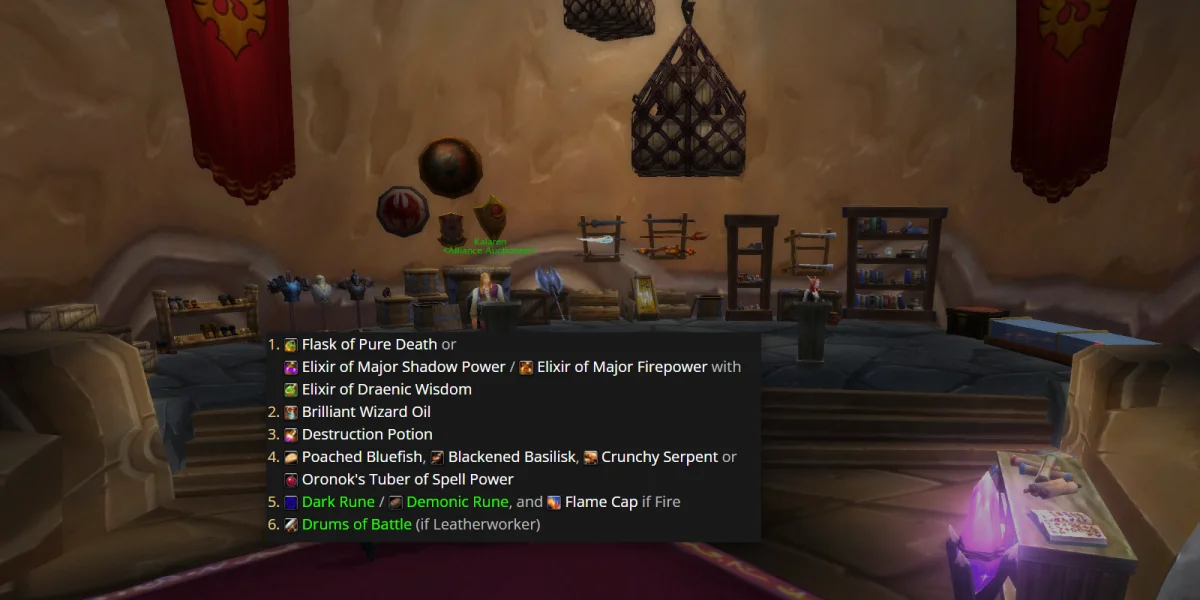
Coming into a raid stocked with the right consumables is part of the job. Here's what Demonology Warlocks should bring:
Flask: Flask of Pure Death provides a substantial boost to both Shadow and Fire spell damage and persists through death.
Food: Blackened Basilisk, Crunchy Serpent, or Poached Bluefish all provide Spell Damage and Spirit, so use whichever you can get your hands on most easily.
Potion: Destruction Potion gives you a burst of Spell Damage and Spell Crit during the encounter. Stack it with your other cooldowns for maximum effect.
Weapon Oil: Brilliant Wizard Oil applies to your main-hand weapon and increases Spell Damage and Spell Crit rating.
Reagents: Stock up on Soul Shards before every raid session. Many core Warlock abilities consume these, and running out mid-raid is a problem you can avoid entirely with preparation.
Mana restoration: Dark Rune or Demonic Rune both restore mana at the cost of health, functioning as backup mana tools alongside Life Tap. Demonic Rune is Warlock-specific; Dark Rune is a general consumable with a similar effect. Bring both if you can.
Situational: Flame Cap increases Fire spell damage and is worth bringing depending on the encounter and how your damage breaks down between fire and shadow.
Kibler's Bits or Sporeling Snack can be fed to your Felguard to increase its stats. Scroll of Agility V and Scroll of Strength V let you buff your pet directly before a pull. The Black Book trinket serves the same pre-pull buffing purpose. Using these on the Felguard before a fight starts is a small but consistent way to get a little extra pet damage.
Final Notes
Demonology Warlock has a clear identity built around the bond between Warlock and Felguard. The rotation won't overwhelm you, which leaves plenty of room to focus on raid mechanics, threat management, and keeping your pet positioned correctly. The Felguard's ability to keep dealing damage when you can't is a genuine and practical advantage in the right encounters. The self-sustain loop of Life Tap into Drain Life also makes Demonology one of the more durable caster DPS specs in the game.
For players who want a spec with a strong identity, a straightforward rotation, and real advantages in chaotic fight environments, Demonology is a fully viable choice throughout TBC Classic.