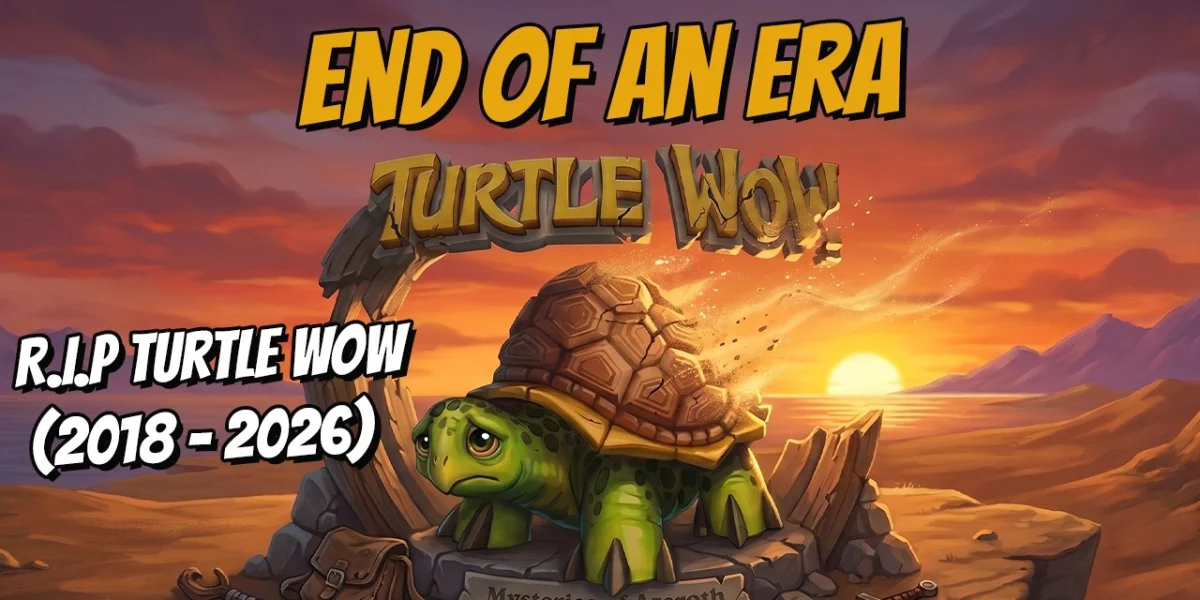
Turtle WoW closes its doors on May 14, 2026. After almost eight years and a community of roughly 160,000 Discord members, the largest Classic private server in existence is getting pulled offline for good. Players who built their second life on Nordanaar, Ambershire, Tel'Abim, or South Sea are about to lose all of it.
Stormforge announced its own closure for the same day. Project Epoch took a Cease and Desist back in September 2025 before getting handed off to Ascension. Everlook EU went offline that same month. The Classic+ scene hasn't seen a year this brutal since Nostalrius collapsed in 2016, and thousands of displaced players are now trying to find their next home.
If you're one of those players, this article walks through the ten best private servers still standing for displaced Turtle refugees, ranked from number ten down to the strongest pick. Each entry covers what the server offers, who it's a fit for, and where it lands in the broader scene right now.
What Just Happened to Turtle WoW
Blizzard filed copyright infringement charges against Turtle WoW in the U.S. District Court for the Central District of California on August 29, 2025, accusing the project of "large-scale, egregious, and ongoing infringement" of Blizzard's intellectual property. The named defendants were a US-based individual identified as the public face of operations and AFKCraft Ltd., the Hong Kong shell company that owned Turtle WoW, plus about a dozen additional contributors. The judge ruled for Blizzard on April 10, 2026 and granted a permanent injunction. A confidential settlement landed three days later, donations went offline the same day, and on April 18 the dev team posted "A Journey's End" to the official forums confirming May 14 as the last day of operation.
The injunction terms are heavy. AFKCraft can't operate, manage, or hold financial interest in any private server tied to a Blizzard property going forward. Code, server software, social accounts, and promotional assets cannot transfer to a "successor" project, which closes the loophole earlier shutdowns used to rebrand and continue. Turtle WoW 2.0, the Unreal Engine remake project, is shut down by name.
Why Turtle, and why now? The targeting makes sense. Turtle ran the loudest marketing operation in the scene, with YouTube ad spends, Facebook campaigns, and staff replying to official Blizzard tweets with download links. Turtle WoW 2.0 was being pitched as a full Unreal Engine 5 recreation, and concurrent player counts north of 13,000 were a public talking point. Combined with a corporate entity Blizzard's lawyers could actually serve, a US-based defendant, and donation channels that left a paper trail, Turtle was sitting on every legal vulnerability that exists.
The Broader Crackdown
Three years ago, a community-circulated dossier alleged that Turtle and Stormforge shared payment processing and ownership signals. At the time, most of the scene dismissed the claims as drama, but the court filings have since validated them. AFKCraft was the parent entity behind multiple servers, which is why several closures dropped at once. Stormforge announced its own shutdown for the same May 14 date and is exiting the Activision/Blizzard private server business entirely. Project Epoch took its Cease and Desist in early September 2025 and handed operations to Ascension. Everlook's EU branch shut down on September 22 of the same year.
Microsoft's involvement is worth flagging. The post-acquisition Microsoft has been pushing this enforcement wave harder than legacy Blizzard ever cared to. The most popular theory is that all of this is groundwork for an official Classic+ announcement, mirroring how Nostalrius came down right before WoW Classic was greenlit in 2016. Nothing's confirmed, but the parallel is hard to ignore.
The Top 10 Best Turtle WoW Alternatives Ranked
10. Felsong (Legion)
For players still chasing Legion, Felsong is the answer. The standard realm runs progressive 7.3.5 content, while Felsong+ is the newer alternative at x10 rates with account-wide artifact power and various quality-of-life additions. Both are run by former WoW Freakz and Firestorm staff.
The numbers are where Felsong falls short. Felsong+ runs at 0 to 100 daily players, with the wider population skewing non-anglophone and peak figures well below what promotional materials suggest. Legion content here is solid, but you'll want to set expectations on community size and language before diving in. Best fit for players who want Legion specifically and don't mind a niche scene.
9. Firestorm
If your target is anything close to retail-style WoW, Firestorm is the strongest option in the scene. The network covers The War Within (with current 11.0.2 content and 11.1.5 class balance), Dragonflight, Shadowlands, both BfA realms, Mists of Pandaria, Cataclysm, and WotLK. Bear in mind retail itself has moved on to Midnight, so this isn't bleeding-edge content, but you won't find anything closer on a private server.
Active concurrent population sits between 2,500 and 4,000, with around 63,000 Discord members on file. The TWW launch went through closed beta in June 2025, open beta in July, and live release on August 25. Anyone looking to skip Blizzard's subscription while playing modern-style content should be looking here.
8. Dalaran-WoW Algalon
Twelve-plus years of operation makes Dalaran-WoW one of the longest-running WotLK projects out there. The Algalon realm reopened on November 1, 2024 after a community-driven decision, and players carry progress across resets through a "Bound to Dalaran" character continuity system. Algalon itself runs progressive WotLK on T7/S5 era content, and the team behind it pioneered the "buffed" or "pre-nerf encounter" approach that's now standard across WotLK servers.
Default rates start at x1 and bump to x3 after server-first achievements. The shop sells cosmetics for content up to level 70 and runs zero pay-to-win at the endgame. Population is small but committed, with a strong reputation among Blizzlike-purist Wrath fans. Anyone who wants Wrath without the loud-server baggage will find this the cleanest option around.
7. Project Epoch
Epoch's launch year was a disaster. July 2025 saw it hit 25,000+ peak concurrent players in 48 hours, but the database choked at "a few hundred extra players" beyond its 2,000-player stress test. By early September, Cease and Desist letters arrived for multiple Epoch staff, who promptly stepped down. Ascension took over, and population fell from 25,000 peak to roughly 200 to 300 daily by early 2026.
Under Ascension, the project has been quietly buried. Epoch is hidden on the main Ascension website, only reachable through a launcher dropdown, and right after the Turtle shutdown news, the launcher was updated to require installing Ascension's 40GB Bronzebeard before accessing Epoch's 16GB client. Players have widely read this as a funnel toward Bronzebeard. The /who command got disabled as Turtle refugees arrived, and the promised content roadmap has barely moved, with Onyxia still the only available raid five months in and Molten Core only just announced.
On April 26, 2026, the situation got worse. Ascension removed the Epoch cosmetic shop entirely with no plans for it to return, and project lead Dutch confirmed in Discord that "the epoch core that was inherited is a mess. Fixes are absurdly time consuming. There are issues and the development is slow." He stated devs are continuing to work on the Kezan and Gurubashi realms "at the same capacity as before," which players read as confirmation that no additional resources are coming. The community split between doomposting and copium within hours, but the underlying message is that Epoch development will continue at its current crawl, with no expansion of staff and no shop revenue to fund one.
A separate issue has affected gold-selling vendors, Boosting Ground included. Ascension runs heavy in-house monetization themselves, but they've been pursuing third-party gold trade harder than any other server in the scene, which reads less like player protection and more like clearing the field for their own shop. They ban gold buyers, then pressure them to leave negative reviews on competitor sites in exchange for unbans. A competing vendor described it on Trustpilot as Ascension "forcing people who bought gold to write down bad/fake reviews." Epoch isn't the only Ascension project visibly neglected either. Conquest of Azeroth, sold to backers at around $130 per alpha slot, has barely moved in months, and Wildcards has stalled out, with development resources visibly funneling toward Bronzebeard.
There's also the question of whether Epoch survives at all. The custom zones, expanded questing, and Classic+ marketing language are exactly the elements that put Turtle in the crosshairs, and Epoch already took one Cease and Desist with no obvious reason a second one is unlikely. The recent population bump is overwhelmingly Turtle refugee migration rather than organic growth. Custom content here is real, but the trajectory has been rough. Buyer beware.
6. Whitemane (Multi-Expansion)
Whitemane operates as a multi-expansion network covering WotLK, Cataclysm, and Mists of Pandaria, with their headline current project being a Cataclysm Classic build running on the modern Patch 4.4 client. That's impressive engineering work, and the combined network sits at 8,500+ concurrent players across roughly 42,000 Discord members.
Anti-GDKP and anti-bot enforcement is in effect, and the team has stated it does not sell gear. A Mists of Pandaria realm is launching in June 2026, with a TBC realm reportedly in development behind it. Whitemane's older reputation included some chatter about heavy-handed GMs, but the recent track record has been better. Whitemane 2.0 is expected later in 2026.
5. Tauri Evermoon
Tauri WoW operates as a Hungarian-international Mists of Pandaria server on patch 5.4.8, with Evermoon as the international (English-speaking) realm running x2 rates. What sets Tauri apart is how cleanly the game actually runs. The community has long held that Tauri does the best job in the scene at making spells, abilities, dungeons, and raids behave the way they're supposed to, with one widely-circulated review calling it "phenomenal." The cross-realm system links battlegrounds, dungeon and raid finder, and the auction house between Tauri and Evermoon, which keeps content active even on quieter days.
Numbers run anywhere from 500 to 3,000 depending on the time of day. For MoP fans, this is the best-running home you can pick.
4. Apollo II
Apollo II is Twinstar's Cataclysm project, run by the same outfit that operates Kronos. The connection matters because the Kronos survival argument (covered at #1) extends to Apollo too. Among Apollo realms, Apollo II is the most active, peaking around 1,500 concurrent players. The technical execution is strong across the board, and the server has held stable for years. There's been some staff-related criticism in the community, but the gameplay holds up. Cataclysm players will find this the most reliable home for the expansion.
3. Atlantiss Karazhan
Atlantiss is the strongest TBC option going right now. The Karazhan realm launched on July 25, 2022 and has held stable populations ever since, running Blizzlike with x1-2 rates and a cosmetic-only shop. Concurrent populations have historically sat in the 3,000 to 5,000 range, putting it among the most populated TBC servers anywhere. Class abilities, dungeons, and raids are all properly scripted, and the team has weathered every crackdown so far without issue.
Netherwing operates as a second TBC realm under the Atlantiss umbrella with the same technical quality. Stormforge's closure is going to push a meaningful portion of the displaced TBC playerbase toward Atlantiss, so expect numbers to climb further.
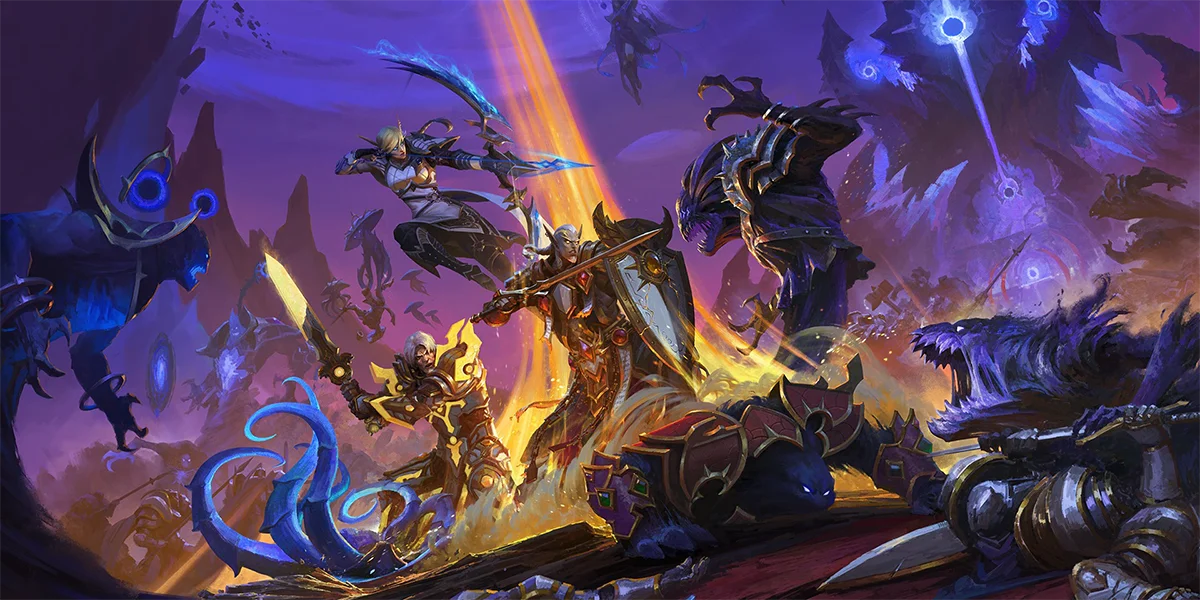
2. ChromieCraft
ChromieCraft is the WotLK equivalent of what Kronos represents in vanilla: a non-profit, no-P2W project run by people invested in the game rather than the revenue. It runs on AzerothCore (the open-source emulation framework), with bug fixes going back into the open-source codebase. What sets ChromieCraft apart is its hyper-progressive level cap, which unlocks content in phases starting at level 19 and climbing through 29, 39, all the way up to 80, replicating how vanilla evolved through TBC and into WotLK. Players actually experience progression rather than rocket-jumping to endgame, with the in-game store carrying Chromiepoints cosmetics under strict no-pay-to-win rules.
Average numbers run 100 to 250, with primetime peaks at 300 to 700+ and some trackers showing higher figures in the 3,500 range. Activity has been climbing recently, with over 4,000 new accounts in the seven days following the Turtle shutdown news. The server has stated it won't progress past Wrath of the Lich King, which is a non-issue if Wrath is your target. Community is tight, moderation is firm.
1. Kronos (Twinstar)
Kronos operates under Twinstar, a Czech project that's been running WoW emulation servers without interruption since December 2008. The original Kronos realm launched in March 2015, and seventeen years of continuous operation later, Twinstar is arguably the longest-running WoW private server organization still active. Kronos 5 launches Saturday, May 9, 2026, five days before Turtle goes dark. The realm is called "Kronos Fresh," running pure Blizzlike vanilla with PvP ruleset, x1 rates, time-gated content following the original 1.12 phase pattern, and a free mount for players active at launch.
The K5 content schedule runs through early 2028, with Molten Core and Onyxia in July 2026, Blackwing Lair in December, Zul'Gurub in February 2027, and Naxxramas closing the timeline. The standout feature is Kronoboon, which lets players bank world buffs in advance and apply them when needed, killing the world-buff logistics problem that used to eat raid nights on every other vanilla server. Monetization stays cosmetic-only with no power, gear, or gold for sale.
What makes Kronos the headline pick is survival. Nostalrius fell in April 2016, Elysium imploded in 2017, Epoch and Everlook went down in September 2025, and Turtle and Stormforge are dying right now. Kronos kept running through all of it. Community discussion credits operational discipline: quiet marketing, hosting outside U.S. legal reach, cosmetic-only monetization, and a Czech corporate structure on paper for over a decade. Nothing in the private server space is bulletproof, but seventeen years speaks for itself.
There are real tradeoffs to know about. Kronos runs pure vanilla, with no custom races, expanded zones, class reworks, or custom raid content. If what drew you to Turtle was the dev team's additions on top of vanilla, Kronos won't replace that. Realms have historically been PvP-only, and populations tend to dip one to two weeks after each fresh launch. Pre-K5 numbers sit between 1,000 and 2,500. Best fit for vanilla purists and anyone who values longevity over feature scope.
Honorable Mention: Warmane
Warmane is the most recognizable name in the WoW private server space and runs the largest WotLK population still online after the May 14 closures. The realm lineup covers TBC, WotLK Blizzlike, and high-rate WotLK, with a seasonal fresh option on the side. The server has gone into low-profile mode after the wave, pulling public counts and download links offline, with the official forum confirming "we are not closing." The "toximane" nickname has stuck for years over the chat culture, and the economy has historically been more permissive of active gold trade than other servers, which won't be a downside for anyone who wants a populated Wrath realm with a busy market.
What Comes Next
Blizzard's playbook is clear at this point. Public U.S. staff, traceable corporate entities, aggressive marketing, and named donation processors are the targets. Quiet operations with cosmetic-only monetization have continued to survive. Kronos K5 on May 9 is the next inflection point and, barring something unexpected, the cleanest fresh vanilla launch the scene has had in years. For the rest, ChromieCraft handles WotLK, Atlantiss owns TBC, Apollo II covers Cataclysm, Tauri Evermoon is home for MoP, and Firestorm handles modern retail-style content. May 14 is coming. Time to get your move in motion.